Books in homeless shelters

Looks like good people doing good work. I realize this might be scary and unfamiliar, but I think it’s important that we witness it now and then.

“The project was inspired by a young homeless man who I met in West London,” the 26-year-old told The Big Issue. “I used to walk by him every single day and every time he would be reading a book on the side of the road. I started talking to him – as a big book enthusiast myself – about the books he was reading and he put across the idea that he was very surprised that more people who were homeless don’t read books. For him it was a distraction from the anxieties that he was facing. That made a lot of sense to me because even when I’m having a particularly bad day, reading books was just an escape from those negative thoughts.”

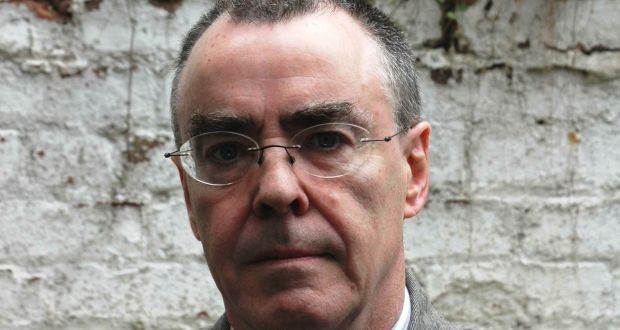
The Brit trying to save giant American bookseller B&N

This dude is trying to turn Barnes and Noble around.

The 55-year-old, tall, slim and soft-spoken, has almost 30 years of bookselling in the UK behind him, first at Daunt Books, the small chain of upmarket shops he founded in Marylebone in 1990 and then at Waterstones, which he took over as chief executive in 2011 as it risked sinking into administration. Waterstones turned profitable in 2016.

Mr Daunt credits the recovery to his decision to make the chain act more like an independent bookshop, with local managers empowered to stock the titles they think will suit their particular markets. He’s plotting a similar strategy now.

“It is relatively simple. Fill bookshops with the books their customers want,” he says.

Whelp, I guess I’ll see you in the Rhianna/Self-Help/Cookbook section.

Trump gets Ladybirded

I didn’t realize this series existed. Would read.

The Ladybirds for Grown-Ups book series has been a crazy-successful phenomenon since its launch in 2015. So many of us (myself included) grew up reading Ladybird books—beautifully illustrated, slim children’s volumes telling charming stories, often fairy tales (my favourites) or informative little nonfiction reads.

I love my librarian

And yours too. And theirs. Browr…. If you’re an American and you’re looking for something to distract you from the fact that you handed the wheel of your suped-up monster truck over to a half-witted, shit-flinging chimp while driving down one of your gold-paved streets at 150, then you might take some time today to nominate your favourite (sorry, favorite) librarian for an award.

Library users have until Monday, Oct. 21 to nominate superstar librarians for the American Library Association’s (ALA) prestigious I Love My Librarian Award. Members of the public can submit nominations online for library professionals who have transformed communities and improved lives. The award recognizes the outstanding public service contributions of librarians working in public, school, college, community college or university libraries in the U.S. Each year since the award was established in 2008, the ALA has selected up to 10 librarians from a pool of hundreds of nominations. This year’s award winners will each receive a $5,000 cash prize, a plaque and a travel stipend to attend the I Love My Librarian Award ceremony in Philadelphia on Jan. 25, 2020, during ALA’s Midwinter Meeting & Exhibits.

Restoring the sex and rage in … Jane Austen

A little something I’ve been caught stealing from the Atlantic for you Jane addicts out there. (See what I did there, other Gen X people?)

The pressure to sand the sharp edges of her plots into “You go girl” fairy tales is also wrong. These are not books about “empowered” women, even though many of the female characters are eloquent, clever, and resourceful. Most of the “happy” endings crumble under scrutiny. Only Elizabeth Bennet really gets it all, as Darcy is a magical combination of hot, rich, morally upright, not boring, not drunk—and not two decades her senior. Austen’s other heroines often profess to be happy, but cracks are visible in their facade. Will Marianne Dashwood really learn to love Colonel Brandon, a much older man who “still sought the constitutional safeguard of a flannel waistcoat”? Or is she, like Charlotte Lucas in Pride and Prejudice, pragmatically settling for a home and family because spinsterhood is so unappealing? Kathryn Sutherland, an English professor at Oxford University who consulted on The Watsons, told me that the characters’ obvious emotional intelligence can make their onscreen representation unsatisfying because it “doesn’t map easily onto the kind of slick romance we want from Jane Austen.”

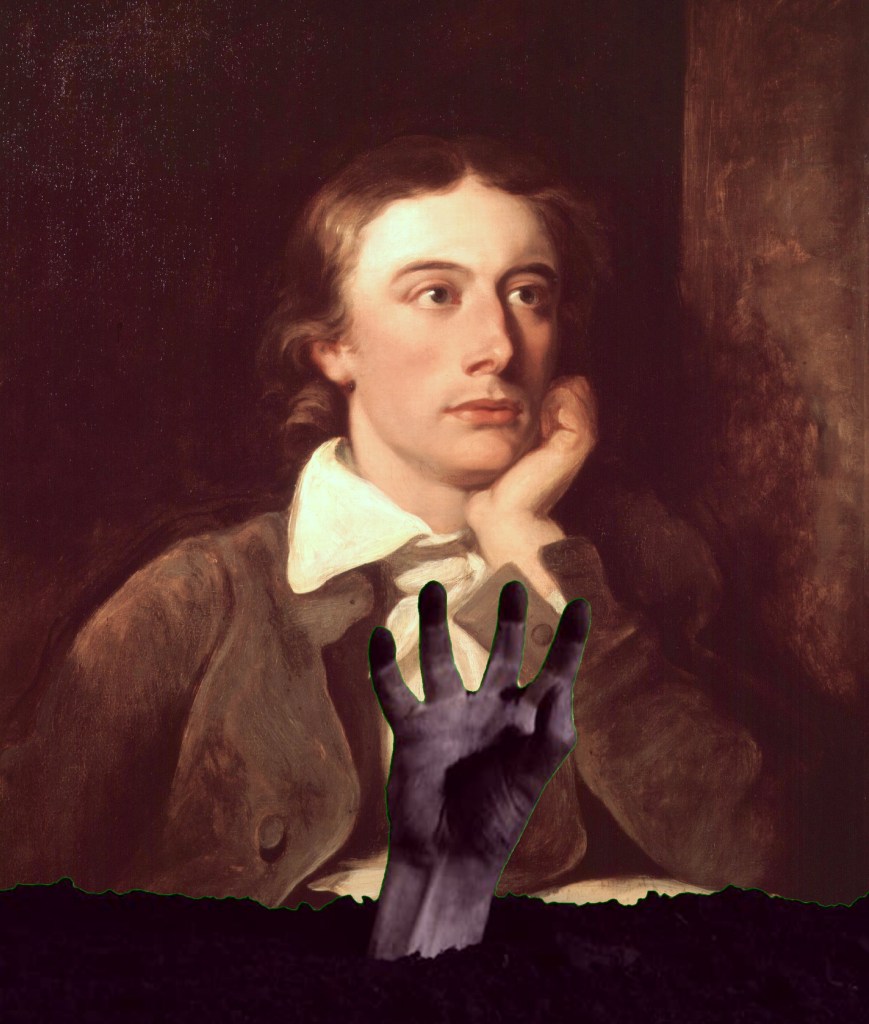
Halloween-month update: Igor Keats?

Was John Keats a graverobber? No, like, actual bodies, not the lines of dead colleagues. This is a supercool conspiracy read. How would it alter his legacy? Hell, I’d get him a movie deal.

But what if Keats’s fixation on the morbid physicality of death and on sites of corporeal decomposition was not (or was not only) anticipatory of his own imminent passing, but was in fact informed by his own intimate experience digging in freshly rumpled graveyard soil?  What if Keats personally got his hands dirty in the illicit nocturnal economy of procuring fresh corpses for medical schools, such as Guy’s Hospital in London, where he had enrolled as a student in October 1815? How would that alter the way we perceive him, his life, and his extraordinary literary legacy?

Poetry is like a drug…store

You’ve heard of emerging poets, but have you heard of “emergency poets?” You can’t unlearn these things, people.

Literature academics from Keele University are opening an innovative “Poetry Pharmacy” to dispense literary “first aid” as a way of bringing the therapeutic benefits of poetry to the local community and to support mental health.

“Emergency Poet” Deborah Alma, a Lecturer in Creative Writing at Keele, and senior lecturer and poet James Sheard have started the venture as a novel way of showcasing poetry, focusing on good mental health and well-being.

The “Poetry Pharmacy”, set in a Victorian shop in the high street of the Shropshire town of Bishop’s Castle, is holding a launch event on Thursday 3 October and will officially open to visitors on Friday 4 October.

(From tip line submission by Art.)

The first novel?

In my house full of teenage gamers, the name “Genji” means something different. But in the literary world, it’s a 1000 year old novel written by a woman in ancient Japan. (Video at link.)

Written 1,000 years ago, the Japanese epic The Tale of Genji is often called the world’s first novel. Following the life and romances of Hikaru Genji, it was written by a woman, Murasaki Shikibu. The tale had an unprecedented global influence; in 1925 an English translation by Arthur Waley was reviewed by Virginia Woolf in British Vogue.

Pullman on genre and bias

Philip Pullman is a damn genius. Here’s the text of a talk he gave telling people to read whatever the hell they want to read. Looking forward to the new adaptation of His Dark Materials for the telly. (Truly one of the best fantasy series I’ve ever read, and ostensibly for children — trailer-that-doesn’t-look-shitty-like-the-movie-from-2007 below.)

Not only that; do we really believe that men have nothing to learn from stories by and about women? That white people already know all they need to know about the experience of black people? Segregation always shuts out more than it lets in. When we say, “This book is for such-and-such a group,” what we seem to be saying, what we’re heard as saying, is: “This book is not for anyone else.” It would be nice to think that normal human curiosity would let us open our minds to experience from every quarter, to listen to every storyteller in the marketplace. It would be nice too, occasionally, to read a review of an adult book that said, “This book is so interesting, and so clearly and beautifully written, that children would enjoy it as well.”