Does writing still matter in the era of climate change?

What’s the role of literature in a time of climate crisis? My guess is “kindling” for where I live. Back in 2003 I wrote a book of poems about climate and political and spiritual crises called The Hunter. A reviewer said something like, “In 20 years, this book will seem either prescient or self-indulgent.” I feel pretty good about the results of that prediction.

But seriously, some days this question is why I have a hard time getting started at work on the book. Feels a bit like when I was an early teen and Reagan was at the button. Why bother? Maybe I need to get a nose ring and a Mohawk.

We are at a moment in time that smacks of grand enterprise gone awry. We need to back out, decide what to relinquish (perhaps highly polluting industries and a colonial conception of home) instead of scrabbling to scaffold our out-of-date dreams of paradise. And the time to do this is now, was now in 1954, and 1970 and now and now and now – there is no other time.

Writing probably doesn’t feel like the most crucial response here, and maybe it’s not. There is lots of other work to be done. But writing can help us see connections, record violence, build empathy, address possible futures. Writing in an emergency means pulling yourself back from the nostalgic deep dive. It means unwriting our lusty paradises, because they never were.

Carol Shields Prize

Susan Swan and Janice Zawerbny have created a new prize for women’s fiction that has a hefty purse, including, as I think all good prizes should, a significant runners-up prize. What’s neatest about this prize is the obligation for the winner to pick an emerging woman to mentor. Good thinking and classy execution all around on this one.

 Swan teamed up with a friend who works in book publishing, Janice Zawerbny, in an effort to continue to level the playing field. The result is a new annual prize, the Carol Shields Prize for Fiction, which starting in 2022 will award $150,000 for a work of fiction published in the previous year by a woman or nonbinary person.

It is a sum that dwarfs the prize money for literary awards such as the Booker Prize (50,000 pounds, roughly $65,000), the Pulitzer Prize for fiction ($15,000) and the National Book Award ($10,000). The Nobel Prize for literature is one exception, with laureates receiving nearly $1 million.

“We wanted to go big on it so that people paid attention,” Swan said. In addition to the $150,000 grand prize, four finalists will each receive $12,500.

On canned writing

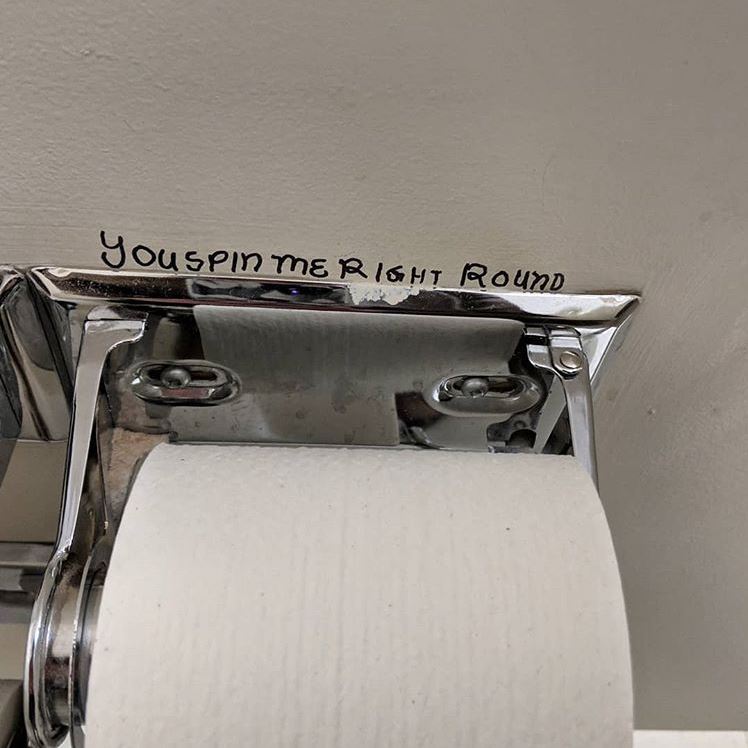
Did you know toilet lit is a thing? My friend Bridget kept an Instagram page that ended up a book of photos on called “What’s Written in the Ladies”. I find it fascinating. I particularly like the exchanges. My favourite was in a restroom at York University where I wasted 40,000 bones on a creative writing degree. It read, “JESUS SAVES!” and below someone had put a smiley with a response: “But Allah puts in the rebound.” It’s nice to laugh as you poop. The Millions has an essay on the form.

Photo by Bridget Canning

What qualifies as urinal lit? Well, technically it’s anything that someone is brave enough to scribble on a bathroom wall. I’ll admit, most of these scribbles are nonsense, as alcohol fuels a tremendous amount of urinal lit (though the same could be said, I suppose, for lit lit). Urinal lit often has a sense of urgency, as well as a clarity typically reserved for a form like haiku. The best urinal lit uses an economy of language that makes Raymond Carver seem positively prolix. The urgency of urinal lit comes from the necessary brevity of scrawling a message in a public place without being seen. Given the amount of graffiti in bar bathrooms, I’m amazed I’ve never actually caught anyone in the act.

Bodice and chest, both ripped

In Canada, we have much to be both proud and ashamed of. For instance, in the first category we have music, comedians, plaid, politeness, peacefulness, telecommunications leadership, etc. In the latter, we have our record on indigenous issues, the tar sands, Peter McKay, etc. I’m not sure what category this fits in, but we’re apparently responsible for the pre-kiss, forehead-nuzzling, often vaguely rapey classic Harlequin cover.

Cover art by Gary McLaughlin, from linked CBC article

Square-jawed heroes clutch swooning women in gazebos — and maximalist living rooms and unidentified tropical locales. Meers’s scenes are typical, as synonymous with romance as Harlequin itself. But for decades, that exaggerated look of love was being mass-produced in Toronto.

Barnes & Noble/PRH back down

Well, that was fast. The lovely clueless folks at Barnes & Noble/PRH have cancelled their ill-conceived blackface publishing project citing that fact that “D’oh, we fucked up.” (Note: I may have made that quoted part up–they in fact have not apologized, but have simply addressed “expressed concerns” from the community.) Ah, whew. Thanks for doing due diligence. I mean, AFTER the damage was done, but still.

Suggestion: whoever was the “Debbie Downer”/naysayer at the boardroom table that day who shook their head–the one on which your hotshot white-guy-led creative contractors brought in the suggestion and most of those assembled nodded their pale, flaxen locked heads–gets a promotion, while those who did the nodding have to wear around the office for a week a sandwich board that reads “I cost the company $XXX,XXX”.

Listen, as a former marketing guy, I know you have to throw stuff at the hoop sometimes and hope it goes in for three; but you need to throw a basketball to get the points, not a clown on riding lawnmower.

In a statement to the Guardian, Barnes and Noble said: “We acknowledge the voices who have expressed concerns about the Diverse Editions project at our Barnes & Noble Fifth Avenue store and have decided to suspend the initiative. The covers are not a substitute for black voices or writers of color, whose work and voices deserve to be heard. The booksellers who championed this initiative did so convinced it would help drive engagement with these classic titles.”

The good thing about mistakes that the work done to repair them can lead to positive outcomes.

In response to the outrage, Penguin Random House announced it will donate $10,000 to the Hurston Wright Foundation, which works with up-and-coming black authors. They are also launching a Twitter donation campaign, giving a dollar to Hurston Wright each time someone tweets the hashtag #BlackStoriesHavePower.

For the record $10,000 is probably the 5% reserve fund they kept aside from paying the contractors to develop the project. I’d love to see this number inflated by a factor of 10. Come on, B&N!

I…. I just…. But…. It’s…. Am I wrong?

Note the Treasure Island designed by Spongebob creators…

Experiment: I want you to play a note on a piano and ask Barnes & Noble, or frankly nearly any major, white-run corporation to identify it. Spoiler: they can’t because they’re tone deaf.

It’s Black History Month! So Barnes & Noble is celebrating by publishing a bunch of largely (Dumas is in there) white-authored books with new covers featuring POC characters, thereby digging itself a PR grave into which its headless corpse is about to fall.

So if B&N have released a series of classic (read: public domain stories by dead white people) books with questionable covers, the question becomes: who are they “rebranded” for? Presumably POC consumers? Feels a little Blackface, no? Not sure that’s gonna fly.

Listen, there’s nothing wrong with encouraging everyone to read classics like Frankenstein and The Secret Garden, but ignoring the fact that many of these public domain stories are still racist, colonialist, and/or socially problematic and remarketing them to POC by simply slapping a new cover on doesn’t… slap.

Why didn’t they publish 12 books for YA readers by actual working POC authors? Well, 1) that would be more work, and 2) it would cut into the profits (all the work rebranded here is public domain).

While I’m glad to see any olive-branch/effort, especially from America in this day and age, I’m still always shocked that an entire table full of adults in a boardroom somewhere agreed this was a good idea and NO ONE SAID WAIT A MINUTE GUYS EVEN ONCE. Am I wrong? Please let me know.

To celebrate the release of the new covers, Barnes & Noble Fifth Avenue is hosting a Diverse Editions Launch & Panel Discussion from 6 to 8 p.m. on Feb. 5. The panel, which will be moderated by TBWA North America’s Chief Diversity Officer Doug Melville, will feature key opinion leaders within the industry including bestselling author MK Asante, literary agent Nena Madonia Oshman (Dupree Miller), Cal Hunter of Barnes & Noble Fifth Avenue, and more.

Geez, I’d love to be a fly on the wall at that panel…