On the joy of reading first drafts

The BBC looks at what we gain from reviewing first drafts of famous works. I have a great book of photographs of the notes on Eliot’s The Wasteland, and one of my favourite possessions is Gorgeous Nothings, which is the same for all Emily Dickinson’s poems jotted onto envelope and scraps and edited by her own hand in ways that sometimes put contemporary experimentalists on notice.
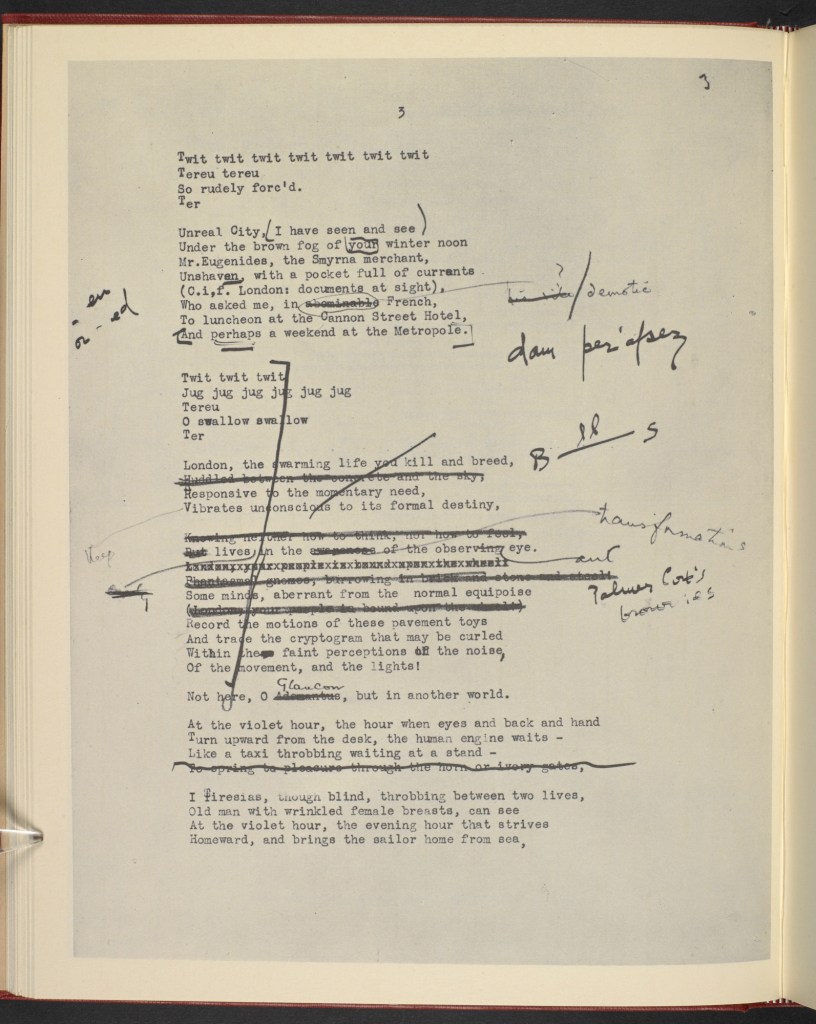
The manuscripts of literary works-in-progress fascinate on many levels, from the flush-faced thrill of spying on something intensely private and the visceral delight of knowing that a legendary author’s hand rested on the paper before you, to the light that such early drafts shed on authorial methodology and intent. Sometimes, the very essence of what a writer is trying to express seems to hover tantalisingly in the gap between a word deleted and another added in its place.

Elsewhere, discombobulating differences can inspire in the reader fresh takes on even the most well-thumbed texts. Openings and endings turn out to have been quite different in their earliest renderings, and beloved characters are to be found taking their first steps bearing very different names. For instance, Gone with the Wind’s Scarlett O’Hara was originally called Pansy, Arthur Conan Doyle’s deerstalker-wearing detective answered to Sherrinford Hope, and The Great Gatsby’s Daisy and Nick were Ada and Dud.
20 percent

How long do you give a book you don’t immediately love before you decide to quit? For me (with fiction) it’s most often 20 percent. If you can’t pull me in in the first 50 pages of your 250 page book, I’m out. With Anne Marie MacDonald’s Fall on Your Knees, though, it took 100 pages before I finally got the groove and eventually loved the book. But until then I couldn’t “get” the narrator. So there are exceptions.

Much depends, of course, on hype, either from people I know or the bookselling machine at large. I’m also more inclined to stick with a book if it makes me laugh even once, which has surely knocked out some worthy, po-faced classics. I’ve lost steam after 100 pages, and I’ve quit in quiet disgust (Really? That’s how you describe an ass?) after five. And of course, these days, I’m more likely to blame quarantine malaise for my disinterest. Do I hate this book, or do I just hate sitting in this chair for the 130th day in a row? I suppose the lesson is that there’s no hard and fast rule, which has never in my life stopped me from wondering if I’m doing it wrong.

What’s it like to debut as an author this year?

Terrible. Ms. Ninja and I both have books coming out next year and we’re both relieved and frightened. Relieved it’s not this year, and frightened next might be just a version of this. This article seems to be mostly about how to get sales, which is not the primary concern of poetry, but really probably should be. If I were a debut author this year, I’d be silently crying the blues for my years of hard work. Do you or someone you know have a book out this year? Leave your thoughts and tears below.

“The toughest thing has been trying to figure out how to monetize these events,” said Jeff Martin, president and co-founder of Magic City Books in Tulsa, Oklahoma. “We get great attendance, but they’re mostly free events. And whereas before we’d have lots of book sales for some of these, that model has not quite solidified yet.”

Many bookstores have experimented with selling tickets to some of their online author events, but Magic City Books has only had success doing that with big name authors, like Colson Whitehead, John Grisham or John Waters.

“It seems like you really need to have those top-tier people to be able to do that,” Martin said. “We’re still trying to figure that out in terms of younger debut authors, or someone who might not have the same name recognition as kind of these ‘celebrity authors.’”

Even more challenging for first-time authors than the move to virtual events is the fact that so many bookstores have been closed, or open just for limited browsing.

“That creates a very challenging environment for debut authors and for publishers who publish them,” said Kristen McLean, an industry analyst with NPD Books. “It’s much harder to get attention and get in front of people from a discovery point of view when the only place they’re looking at books is online or in a mass market retailer when they happen to be there to pick up their essentials.”

Do not click the link below

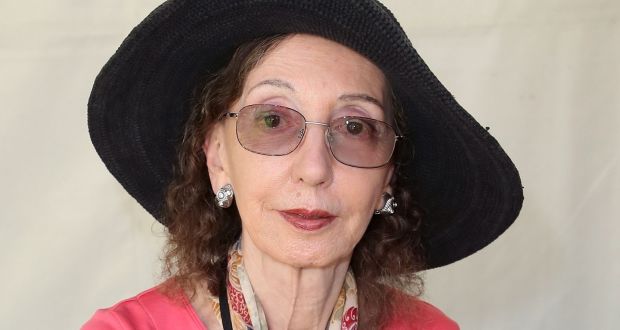
Jeebus. So, the other day, I saw erstwhile drunk-tweeter Susan Orlean post something self-deprecating that despite the drunk tweets, at least she’s not posting pictures of her gross feet. So instead of smartly allowing the internet to filter what this was about down to my foot-averse brain, my piqued curiosity drove me to take a deep dive into the web to figure out what was going on. That was…. a mistake. I now know this and pledge to never follow a mysterious foot story in the dark ever again. See, I already have a thing against feet. I can never understand people who seem to regularly post their feet pics on social media. Surely there are other ways to show us you are relaxing than a shot of your toes on a dock/gunwhale/ottoman/etc. Feet are to me like the mouth-sounds of the eyes. It’s like someone chewing moistly in your ear, but right into the peepers.

I mostly find them unbearable to look at. In fact, I’d go so far as to say I find them irrationally offensive. Anyway, the spoiler here is Joyce Carol Oates went hiking in sandals and obviously stepped in some giant hogweed and now her foot looks like an effects reel from an early John Carpenter film. The tweet is embedded in the story at the attached article. But you’ve been forewarned. I am off to the hardware store to get some bleach for my eyes.

Oates later tweeted: “thank you for all your suggestions & sympathy. I have subsequently seen a doctor, am taking antibiotics & have steroid cream. doctor doesn’t know what it is, however — venomous weed or insect. (also had a tetanus shot.) pain & itching have subsided. moral is: proper footwear!”

After her foot nearly broke the internet, with headlines including “Joyce Carol Oates’ foot photo is freaking everyone out,” she took again to Twitter to say: “(what is most embarrassing about this incident is that my late husband Charlie Gross was an avid hiker & always stressed proper footwear: always proper hiking boots w/ two pairs of socks, & laces tight; for ordinary woods, hiking shoes, always w/ socks. he would be scandalized.)

On the importance of media tie-ins

I deeply dislike the Scholastic book calendar that comes to my kids’ schools every month or so, mostly because it’s filled with tv/movie-tie-in crap, much of which has plastic toys or stickers or CDs or games attached. I even went on Q to complain about it back when we thought Jian Ghomeshi was just a general douchebag as opposed to an abusive, alleged rapist. But this article argues that they have their place and are important in their own right, at least in the “stepping-stones-to-reading” way.

In this current era of streaming, even the most avid television lovers may find themselves with content-fatigue. If you’re a fan of genre television, especially, the days of only a handful of sci-fi series running are long gone. Netflix, Hulu, and HBO Max have blown open the field by making many of the classic shows available while also continually producing new content. Superhero fans, in particular, could drown in the amount of series coming out, as the various television corners of the DC Universe continues to build to overwhelming heights. There once was a time, though, not long ago, that if there was a genre show that you loved… well, there was nothing else like it. Star TrekBuffy the Vampire SlayerCharmed, and even series as recent as Supernatural began at a time when if you wanted something more just like it, you wouldn’t find it by flipping the channel… you’d find it at the Sci-Fi and Fantasy section of your local bookstore. Licensed media tie-in novels were once the genre fan’s way to fill the heart and soul with more stories, and it’s time we look back on these beautiful books and give them the respect they deserve.

Someone get this writer a medal

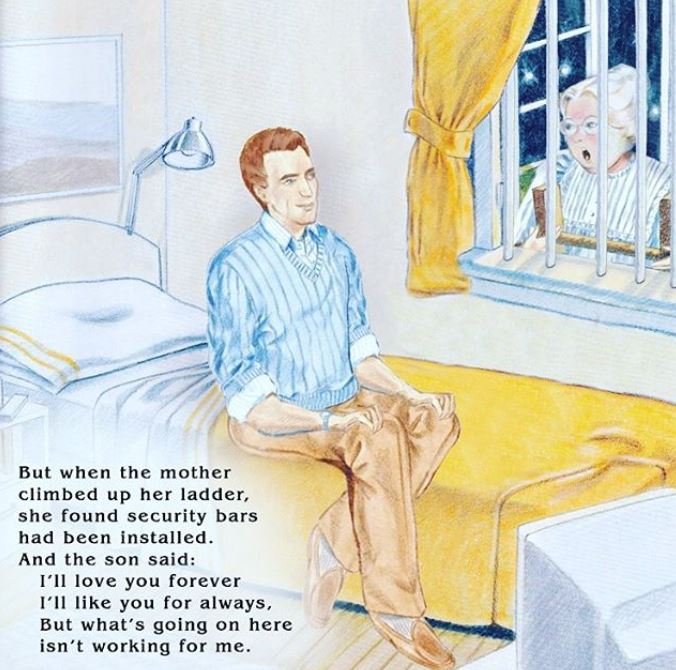
Oh my god, is this overdue: beloved, but problematic kids stories rewritten to eliminate the creep-factor. For years I have been complaining about these books and what they teach both children and parents, with the most insidious of the horror stories being “Love You Forever”. Yes, that creepy-assed mom at the window is actually scarier to me than psychopath kid who slowly consumes an entire tree in what is surely an unintentional metaphor for toxic masculinity, the self-erosion of capitalism, and perhaps even cannibalism. I mean, look at her in this pic. It’s like Salem’s Lot. Bravo, weirdo writer who had the gumption to do this.

Payne got the idea to start re-writing the endings to children’s books when he was tasked with reading a book aloud for a storytime to raise money for the Atlanta Artist Relief Fund. He was trying to find a book to read when he came across The Giving Tree on his bookshelf. The Giving Tree tells the story of a boy who takes a lot from a tree who gets nothing in return. Depending on who you talk to, it’s the story of selfless love or an abusive relationship.

“I came across The Giving Tree on my shelf and thought, ‘Ugh. I hate the Boy. The Boy is the worst.’ And then I joked with my husband about how there should be an alternate ending where the tree sets boundaries and they enjoy the benefits of an interdependent relationship. And then I remembered I’m a writer and I could just do that,” Payne tells Scary Mommy.

Welcome back

Alright, vacation is over, maggots, and your mama ain’t here to protect you anymore. So, stop relaxing and get back to fretting. It’s time to start worrying about school and how capitalism doesn’t care if you and your children are safe, it just wants everything back the way it was unless you can think of something more profitable for the people at the top. Now drop and give me 20! (Pages, folks, pages. I’m not a monster.)

Are you gagged with a spoon by today’s massively gnarly/dope/fresh slang?

Did I get that right, kids? Surely, I’m with it. Yeah. Yeah. It’s not me who is the problem, it’s the children.

Given the current volatility of modern culture, it’s unsurprising that many examples of 2020’s most popular slang includes terms like “Karens”, “OK Boomer”, “cancel/canceled” and “tea”. “Karens” and “OK Boomer” are used dismissively, while the word “tea” stands in for truth. “Cancel/canceled” is pretty self-evident. These are words for expressing anger and frustration.

Now, popular language changes rapidly because we have constant access to new terminology via the internet. So, what makes up our individual speech patterns? In Because Internet: Understanding the New Rules of Language, linguist Gretchen McCulloch uses the example of “soda” to showcase how a name of a word can vary across regions (“pop” or “coke” elsewhere).