The Irish Times looks at why we must work to raise a new generation of readers. In this house we’re batting 50% with the readers: a reluctant, late reader who is now voracious, a natural early reader who can’t stand it, a natural early reader who can’t stop reading, and a reluctant, late reader who can’t be bothered. All of them were read to regularly, all had shelves of books right in their rooms, but all came out different. So, my point here is like my point with all things parenting: do your best to lead by example and cross your fingers. If they came out with a manual on how to operate their wee machines, we’d probably have an easier time of it, but they don’t. It’s mostly guesswork, mistake acknowledgement, and consistency that will serve you best. Good luck not fucking them up, people!
Reading is a pleasure but it is also a unique form of mental exercise. Allowing children to create their own interpretations of constructed worlds in their minds is a gift which cannot be replicated by any other form of media. Of course visual media has its place but it doesn’t allow us to fill in the gaps. Ask a child to draw a picture of Peppa Pig and they will give their closest rendition of the well-known cartoon character. Ask them for a picture of CS Lewis’ Mr. Tumnus and you will get all sorts of variations.
And that is why we must always fight for our children’s right to read. And not only read in school, but under the covers when they know they’re supposed to be in bed. Or when they’re trying not to feel sick from reading in the car, or on the bus, or basically anywhere because they need to finish the page, the chapter or the book. We must let our children be themselves and become themselves through the books they choose to read and give them the respect to know their own minds.
Well, my fellow Canadians, I hope you were able to connect with family and friends this weekend past, and that you gave thanks to whomever you are inclined to thank. I also hope that you spent some time discussing or thinking about what this holiday represents for Indigenous People here especially in a time when politicians use the term Reconciliation as a way to garner votes and praise, but don’t follow through on it. Americans, well, jebus… I don’t even know what to say to you, with your Columbus Day. When I lived in NYC for a good few years, I told friends I found it sort of like their descendants 500 years from now celebrating Hitler Day. This was not what anyone wanted to hear. But I stand by it.
You made it again! Except those of you not reading this because you died. But the rest of you made it! Rejoice. Now you can for two days pretend your life is something you have control over and that you’re not trading your waning moments to make other people rich. Bask now in this moment, because who knows about next Friday?
Should book blogs make political endorsements? Yes, says Biden backing Bookriot… FTR, it’s not my election, but my son is American and I’d love him to have the option to go there some day if he wants and find a different place than is currently on offer;
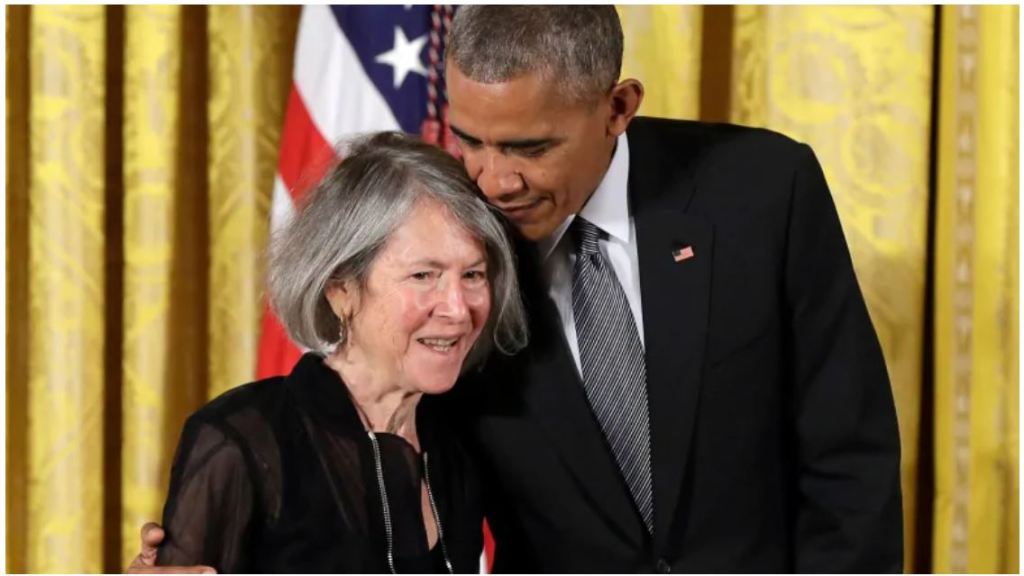
After years of controversy, the Nobel eggheads finally got it right again. I had hoped for a surprise Margaret Atwood win, or an Anne Carson, but this is just as good, really. I have been studying and closely reading Glück’s work since 1994 when an old mentor prof of mine introduced me to her stuff in our Poetry of the United States undergrad course. A brilliant choice all around, and much deserved.
(This quote below pretty much sums up why I’ve always kept a day job on the side instead of just (only) drinking and carousing like a caricature of a poet from a poorly remembered reading of a Beat novel.)
Glück in 2016 with my Forever President.
“When I was young I led the life I thought writers were supposed to lead, in which you repudiate the world, ostentatiously consecrating all of your energies to the task of making art,” Glück said. “I just sat in Provincetown at a desk and it was ghastly – the more I sat there not writing the more I thought that I just hadn’t given up the world enough. After two years of that, I came to the conclusion that I wasn’t going to be a writer. So I took a teaching job in Vermont, though I had spent my life till that point thinking that real poets don’t teach. But I took this job, and the minute I started teaching – the minute I had obligations in the world – I started to write again.”
If I see the word “cuck” used it’s usually an easy block-flag for me, but did you know it took quite the literary road to get here and into the mouth of hate-filled man-babies on the internet?;
I’d like to get this dictionary of Irish English to match our dictionary of Newfoundland English… speakers who know how to speak with great metaphorical acuity;
I came across this article in which an interviewed writer says that hearing people refer to “fun” books (ie, popular, mainstream fiction) as a “guilty pleasure” made her sad, and I thought: yes. In fairness, I used to refer to my SciFi and Fantasy reading that way as well. But I’m not sure I need the self-deprecation anymore. The world is so strange even major mainstream literary writers like Atwood, Ishiguro, Mitchell, and many others are dipping their toes into the speculative to explain it. Hell, Atwood’s Oryx and Crake features an extended chase scene between a man and a hyper-intelligent feral pig that would put a Vin Diesel movie to shame (well, I think probably there are other reasons for shame in some of those… butI digress). But somewhere along the line, I feel like I was self-pressured to “smarten up” my reading with literary titles and stay away from the more “pleasurable” books of pop culture. I’ve found things to enjoy in all of them, of course, but I don’t discriminate anymore, lest I end up like a jaded PhD student who doesn’t know how to read for pleasure anymore. Too much critical thinking, too few critical hits. It’s sort of similar when you are a writer. You get to know the insides storytelling so well, you lose your ability to do anything but dissect what you’re reading. I was that way with theatre after many years of acting. I only see the blocking and directorial choices. Hillary Mantel laments it, as does John Banville. So why do we do it? Yes, it’s difficult, but I think some of this is just myth-building; trying to make others believe that we are working in the arcane and breaking a sweat. I’ve dug ditches, dudes. We’re not breaking a sweat. Not really. Anxiety? Doubt? Self-revulsion? Sure. However, in the end, it’s just telling a story. Some do it better/quicker/more often than others, but anyone can do it. I often say this to my first year poetry students: the only difference between you and me is that I am about 30 years of daily practice and reading up on you. So, if you’re not reading because you find it a chore, go get something that speaks to you off the front table at Indigo (ed note: don’t actually shop at Indigo) in the way a blockbuster movie or sultry novel might. See yourself in it, and get back the habit of reading for fun. Then you can move around from there. Like that time I read a Wally Lamb book and immediately switched to Coatzee. It was like skydiving. Exhilarating.
Popular is okay
Popular fiction makes us escape, feel and think. With every turned page, we are thrown into the lives of characters, who become our friends or mortal enemies. We fall in love, we laugh, we cry and we are chilled to our bone. These books have the power to make us think about our own lives, often changing how we see ourselves and the people around us. Yes, it often tackles complex and emotional themes, but it does so in a relatable, well constructed, entertaining way.
Popular fiction is written for readers, with one aim, to reach as many people as possible. That doesn’t mean it isn’t well written. In fact, it takes a great deal of time, to ensure a manuscript is an “easy read”, with an engaging plot.
The good news is that people have always read popular fiction: Dickens, Shakespeare, Christie, all writing for the mass market. Unfortunately, there is some literary snobbery at play, with a perceived hierarchy between literary and popular fiction.
When I hear a reader say that popular fiction is their guilty pleasure, it makes me sad. No reading experience should be perceived as any less valuable than another. Read books that give joy and entertain you. Here’s my cautionary tale – while we need genre labels to help readers decide what to read next, if you choose to stay in one book lane, you may miss out on a fantastic read.
Lots to cross your fingers for this week… Prizes, new book receptions, good weather, recovery plans, the Christian Right witnessing (see what I did there?) God smite their chosen anti-Christ.
New conspiracy theories abound (I admit, when the news broke on the weekend, my first thought was: he’s just trying to subvert the process, I want to see the lab report)… The Economist gives us a nutbar glossary to help;



 Bookninja