My question would be: will any Trumpets that buy a book he somehow manages to convince a major house to publish actually read it? And where would they store it? Next to the other books—hahahahahah–sorry, hard to keep a straight face;
A lovely PBS profile of ‘Ninja favourite Merwin and his plot of palm trees in Maui. This is a man who tends things and finds beauty in letting them become wild within that conservancy. We lost Merwin last year, but I’m sort of glad he didn’t have stick around for all this shit. He’d seen and processed enough in his time. More text at the site linked above.
What if? What next? What the fuck? The age itself is changing art and writing and even thinking right before our eyes. Are we in a dystopia? Is a utopia coming? What if it’s new prefix? How can we tell fact from fiction? Propaganda from narrative? Pipe dream from possibility? An interesting essay.
To experience 2020 in real time has been like watching a bad flip-book in which each page comes from a different narrative. We’ve had an election narrative, a wildfire narrative, a pandemic narrative, an uprising narrative, a coup narrative. We’ve been winning. We’ve been losing. We’ve had no idea.
Each day peeled a layer from the previous one, revealed it as a lie, a provisional hypothesis that had to be discarded in favor of a different model, one that better fit the evidence. Now, we want desperately to be at the end— the final unmasking that reveals the ultimate answer. We want good to be rewarded, evil to be punished, and the struggle to be over.
But speculative fiction is a genre of narrative with rules, and those rules make it hard to understand where we’ve been and where we’re headed. Speculative fiction wants to organize around a central question; it wants to exclude the sticky, tricky anomalies in its threads; and it wants to move toward closure. These features make narrative a great way to obscure unpleasant facts, to turn life into a bedtime story where things used to be bad, but got better, and now we don’t have to worry about them anymore. But life isn’t speculative fiction.
We may not want to hear it, but our job is to just keep worrying.
Putting together a reading list for a new creative writing program, I saw an opportunity to diversify and decolonize. As allies to writers of color, we white guys can tackle the privilege of “longform patriarchs,” as Bernardine Evaristo calls them. A reading list is part of that work, but not the whole story—often, it won’t be assimilated by white colleagues crying identity politics. My hope, though, is that when a person of color learns from a writer who looks like her, it makes her desired writing career more possible. And for white writers, it shows us we exist in a panoply of talent. We need not simply read black, indigenous, non-cisgendered writers, but learn from them. Let’s change the names we go to as a matter of course. Not McKee, but Shawl. Not King, but Unigwe. Not for ally points, but in order to write better.
There aren’t as many as there should be, no doubt due to publishing’s bias toward whiteness. These books below are some of those I’ve come to draw upon in asking who gets to produce knowledge, to direct how we learn the craft. Let’s make some room on the shelf for these and others that, hopefully, will follow them.
We remember and we forget. Lots of people know that marijuana makes us forget, and researchers in the sixties and seventies wanted to understand how. They discovered that the human brain has special receptors that perfectly fit psychoactive chemicals like THC, the active agent in cannabis. But why, they wondered, would we have neuroreceptors for a foreign substance? We don’t. Those receptors are for substances produced in our own brains. The researchers discovered that we produce cannabinoids, our own version of THC, that fit those receptors exactly. The scientists had stumbled onto the neurochemical function of forgetting, never before understood. We are designed, they realized, not only to remember but also to forget. The first of the neurotransmitters discovered was named anandamide, Sanskrit for bliss.
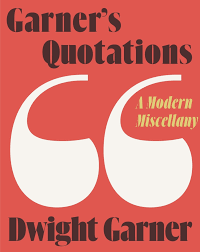
Are you one of those people who writes down interesting snippets of things you hear or read in a notebook? You’re keeping a commonplace book, then. Dwight Garner does the same and got a book out of it. It’s a funny thing about quotes, whenever I read from one of my books of aphorisms, someone inevitably asks me whether all entries in it are written by me. My usual reply is, “I certainly hope so,” but on the inside, I think, “Who would publish a book of other people’s aphorisms with their own name on the cover?” Now, in fairness, I think this guy’s been at it quite a bit and has some interesting connections to make, but there’s my answer.
The contrast between Conroy and McPherson could not have been more stark. Conroy was tall, white, and boisterous; McPherson was short, black, and shy. Conroy cursed, yelled, laughed, and joked; McPherson rarely spoke at all, and when he did his voice was so quiet you often could not hear him. The students dominated his workshops. I was disappointed. McPherson was a Pulitzer Prize winner, after all, the first African American to receive that honor for fiction. He was the recipient of a MacArthur “Genius” grant, as well as countless other awards. I wanted his wisdom. I wanted his insight. He gave it mid-semester, when it was time to workshop my first story.
“Before we begin today,” he said, “I’d like to make a few comments.” This was new; he’d never prefaced a story before. A smile crept on my face as I allowed myself to imagine him praising me for my depiction of a den of heroin addicts, for this was not easy to do, requiring, among other things, an intimate knowledge of heroin addicts and a certain flair for profanity.
“Are you all familiar with gangster rap?” McPherson asked. We were, despite the fact that, besides me, all of the students were white and mostly middle to upper class. While we each nodded our familiarity with the genre, McPherson reached into a shopping bag he’d brought and removed a magazine. He opened it to a premarked page on which was a picture of a rapper, cloaked in jewelry and guns and leaning against the hood of a squad car. Behind him was a sprawling slum. “This person raps about the ghetto,” McPherson said, “but he doesn’t live in the ghetto. He lives in a wealthy white suburb with his wife and daughter. His daughter attends a predominantly white, private school. That’s what this article is about.” He closed the magazine and returned it to the bag. “What some gangster rappers are doing is using black stereotypes because white people eat that stuff up. But these images are false, they’re dishonest. Some rappers are selling out their race for personal gain.” He paused again, this time to hold up my story. “That’s what this writer is doing with his work.” He sat my story back on the table. “Okay, that’s all I have to say. You can discuss it now.”
For a few seconds, the only sound in the room was of my labored breathing. And then someone said, “McPherson’s right. The story is garbage.”






 Bookninja