News broke yesterday afternoon that an old friend of mine, poet Richard Vaughn, has gone missing in New Brunswick. He’s been known to unplug and just take off for a while (dude has a flip phone, of course), so I hope this is the case. If you have information on his whereabouts, his family and friends are quite worried. Please contact the police in NB or your local authorities, or even me by email, if you know anything.
I’m not a big fan of self-help. I think it’s generally very predatory part of our industry, hanging like a vulture over the vulnerable and disillusioned. Most creative writing books are similar; self-help for the person more interested in being told what to do than writing. But over the years, first as a student and then as a teacher, I have read/assigned the occasional text or essay on craft. I prefer to assign actual poems over writing about poems, but when I do, I mostly try to keep things focused on the tools in the toolbox, not the mindset, yogafication, and “spiritual journey” stuff. I figure people have that down or they don’t, and they’re coming to me for the nitty-gritty files and awls of writing. So, for instance, I would 100% assign Fussell’s Poetic Meter and Poetic Form, but would steer clear of Poet X’s MFA-oriented cash-grab vanity work Finding Your Sacred Self in Each and Every Line You Channel From the Godhead Muse and Loving Yourself While You Do It. In the end, if you’re actually interested in reading someone else’s riffing on writing, my suggestion is you keep it to one or two books max (Guardian has suggestions), because like parenting books, they’ll all tell you something different and you’ll end up spending more time trying to decide which one to follow than you do trying to lead by actually writing.
Writers writing about writing can become a supercilious endeavour; I’m more interested in the process of making work and the writer’s perspectives that substantiate the framework.
There’s no single authority, anything is possible. All that’s required are some words and an idea – which makes the art of writing enticing but also difficult and daunting. The books listed below, diverse in their central arguments and genres, guide us towards more interesting and lateral ways to think about what we want to say, and ultimately, how we choose to say it.
The Irish Times looks at why we must work to raise a new generation of readers. In this house we’re batting 50% with the readers: a reluctant, late reader who is now voracious, a natural early reader who can’t stand it, a natural early reader who can’t stop reading, and a reluctant, late reader who can’t be bothered. All of them were read to regularly, all had shelves of books right in their rooms, but all came out different. So, my point here is like my point with all things parenting: do your best to lead by example and cross your fingers. If they came out with a manual on how to operate their wee machines, we’d probably have an easier time of it, but they don’t. It’s mostly guesswork, mistake acknowledgement, and consistency that will serve you best. Good luck not fucking them up, people!
Reading is a pleasure but it is also a unique form of mental exercise. Allowing children to create their own interpretations of constructed worlds in their minds is a gift which cannot be replicated by any other form of media. Of course visual media has its place but it doesn’t allow us to fill in the gaps. Ask a child to draw a picture of Peppa Pig and they will give their closest rendition of the well-known cartoon character. Ask them for a picture of CS Lewis’ Mr. Tumnus and you will get all sorts of variations.
And that is why we must always fight for our children’s right to read. And not only read in school, but under the covers when they know they’re supposed to be in bed. Or when they’re trying not to feel sick from reading in the car, or on the bus, or basically anywhere because they need to finish the page, the chapter or the book. We must let our children be themselves and become themselves through the books they choose to read and give them the respect to know their own minds.
Well, my fellow Canadians, I hope you were able to connect with family and friends this weekend past, and that you gave thanks to whomever you are inclined to thank. I also hope that you spent some time discussing or thinking about what this holiday represents for Indigenous People here especially in a time when politicians use the term Reconciliation as a way to garner votes and praise, but don’t follow through on it. Americans, well, jebus… I don’t even know what to say to you, with your Columbus Day. When I lived in NYC for a good few years, I told friends I found it sort of like their descendants 500 years from now celebrating Hitler Day. This was not what anyone wanted to hear. But I stand by it.
You made it again! Except those of you not reading this because you died. But the rest of you made it! Rejoice. Now you can for two days pretend your life is something you have control over and that you’re not trading your waning moments to make other people rich. Bask now in this moment, because who knows about next Friday?
Should book blogs make political endorsements? Yes, says Biden backing Bookriot… FTR, it’s not my election, but my son is American and I’d love him to have the option to go there some day if he wants and find a different place than is currently on offer;
After years of controversy, the Nobel eggheads finally got it right again. I had hoped for a surprise Margaret Atwood win, or an Anne Carson, but this is just as good, really. I have been studying and closely reading Glück’s work since 1994 when an old mentor prof of mine introduced me to her stuff in our Poetry of the United States undergrad course. A brilliant choice all around, and much deserved.
(This quote below pretty much sums up why I’ve always kept a day job on the side instead of just (only) drinking and carousing like a caricature of a poet from a poorly remembered reading of a Beat novel.)
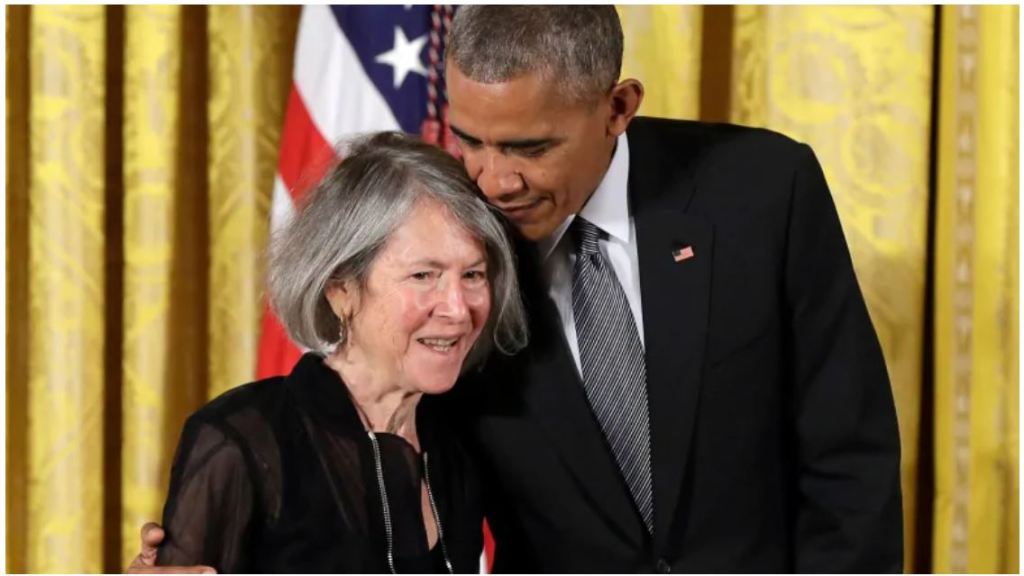
Glück in 2016 with my Forever President.
“When I was young I led the life I thought writers were supposed to lead, in which you repudiate the world, ostentatiously consecrating all of your energies to the task of making art,” Glück said. “I just sat in Provincetown at a desk and it was ghastly – the more I sat there not writing the more I thought that I just hadn’t given up the world enough. After two years of that, I came to the conclusion that I wasn’t going to be a writer. So I took a teaching job in Vermont, though I had spent my life till that point thinking that real poets don’t teach. But I took this job, and the minute I started teaching – the minute I had obligations in the world – I started to write again.”






 Bookninja