
TLS has announced the shortlist for the Mick Imlah prize.
This dorkus malorkus and his colleagues are working on the definitive Latin dictionary. (Audio here if you are sick of using your eyes like a chump.)
It’s called the Thesaurus Linguae Latinae. And it’s considered “the most authoritative dictionary of ancient Latin.”
Researchers in Germany have spent the last 125 years working on the project. By their own estimates, they don’t expect to wrap up until at least 2050.
Lexicographer Adam Gitner spoke to As It Happens host Carol Off about the arduous process of compiling each entry and what keeps him going.
God, I long for the days when I laboured under the illusion that we artists were somehow better people. I mean, it wasn’t a very LONG span of time, but it was blissful and heady. Even committee members hate the Handke Nobel.
Peter Englund, the former permanent secretary of the Swedish Academy, told Swedish newspaper Dagens Nyheter on Friday that he would not participate this year because “to celebrate Peter Handke’s Nobel prize would be gross hypocrisy on my part”. Handke was set to give a press conference about his win at noon on Friday, with his laureate’s lecture due on Saturday. Formal presentation of his medal is timetabled for Tuesday.
An indy bookstore won free rent for a year. Free is exactly my favourite price-point!
Elysia French and Graham Thompson were living in Kingston, Ontario, where French was finishing her PhD at Queen’s University, when they got the news: the couple had won free rent for a year on a downtown storefront in their hometown of St. Catharines. The couple, who admit to squabbling over how they organize the hundreds of books in their home library, always dreamed of opening their own store. Suddenly, it was happening.
This woman took the journalism path to get there, as opposed to the hordes of others that I suspect just didn’t know what else to do in life after high school and so went for a CW degree. Hanging out with writers somehow seems to always lead to writing, instead of taking their appearance and behaviour as a dire warning to flee. Huh. v
emmatroakehhm@gmail.comOne fateful night in Dallas, a poet came to read. I had never heard of her. It was Elizabeth Bishop. I was late. The auditorium was packed. I stood at the back, in the doorway, the only place left. I was grateful I didn’t have to interview anyone. I had quit journalism and was working as a waitress, trying to write poetry. At the time, I was writing a poetry stumbling somewhere between surrealism and the haunting, lilting lyric of the country western music I had been raised to.
I was floundering, but learning to trust in my materials, in poetry. Just barely visible over a podium, Bishop was in a spotlight, her close-cropped silver hair glinting. Her round head shown distant and steady as a planet. The audience was hushed, still, calm. Bishop was shy, devoid of the flamboyant, and a terrible reader. But it didn’t matter. As in all of Bishop’s poetry, one could sense the presence of the ordinary and the eternal, her steady, uncanny attention to the actual.
It’s also Chinese science fiction. I have Cixin Liu’s Three Body Problem here and have been meaning to read it for a good few months. Sadly, I decided to rekindle Bookninja with my spare time instead. Dumbass.
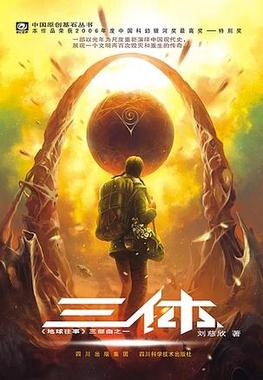
It’s no surprise that sci-fi is booming in China, where the breakneck pace of technological transformation can feel surreal. Economic growth has lifted hundreds of millions of Chinese citizens out of poverty, and brought extreme wealth to the upper and political class, but technology has also become a tool of state oppression. Some Chinese factories have outfitted workers with devices that measure brain-wave activity to monitor their emotional fluctuations and alertness. Bird-shaped drones have been used to surreptitiously spy on citizens, and surveillance through facial-recognition technology is widespread. On social media and messaging apps, posts containing certain banned words are automatically censored. China is now also leveraging its technology to conquer the solar system: After lagging behind in the space race for decades, the nation recently made a historic landing on the far side of the moon, where it has plans to build a permanent research base, and aims to have a rover exploring Mars next year.
Wait, “upper and political class”? I thought they were communists…. Oh, riiiiiiight. [Taps side of nose]
So, the lame duck Taylor non-fiction prize (not using the sponsor’s name anymore since they decided to pull out) has given us a longlist. If books with 25 word titles turn your crank, then check out Quill for the details.
When and how do biography and memoir become history?
How many of these biographies count as history? It was once thought, as Michael Holroyd called it, ‘the shallow end of history’, unable to provide sufficient context and with a tendency to exaggerate the role of individuals in the passage of time. Most scholars wouldn’t now deride the telling of individual life stories as an illegitimate form of historical pursuit, but it still has its critics.
Sherwin Tjia gets a nice profile at the CBC around his new graphic novel, Plummet, in which the Earth suddenly disappears, leaving all the stuff (and people) on it behind.
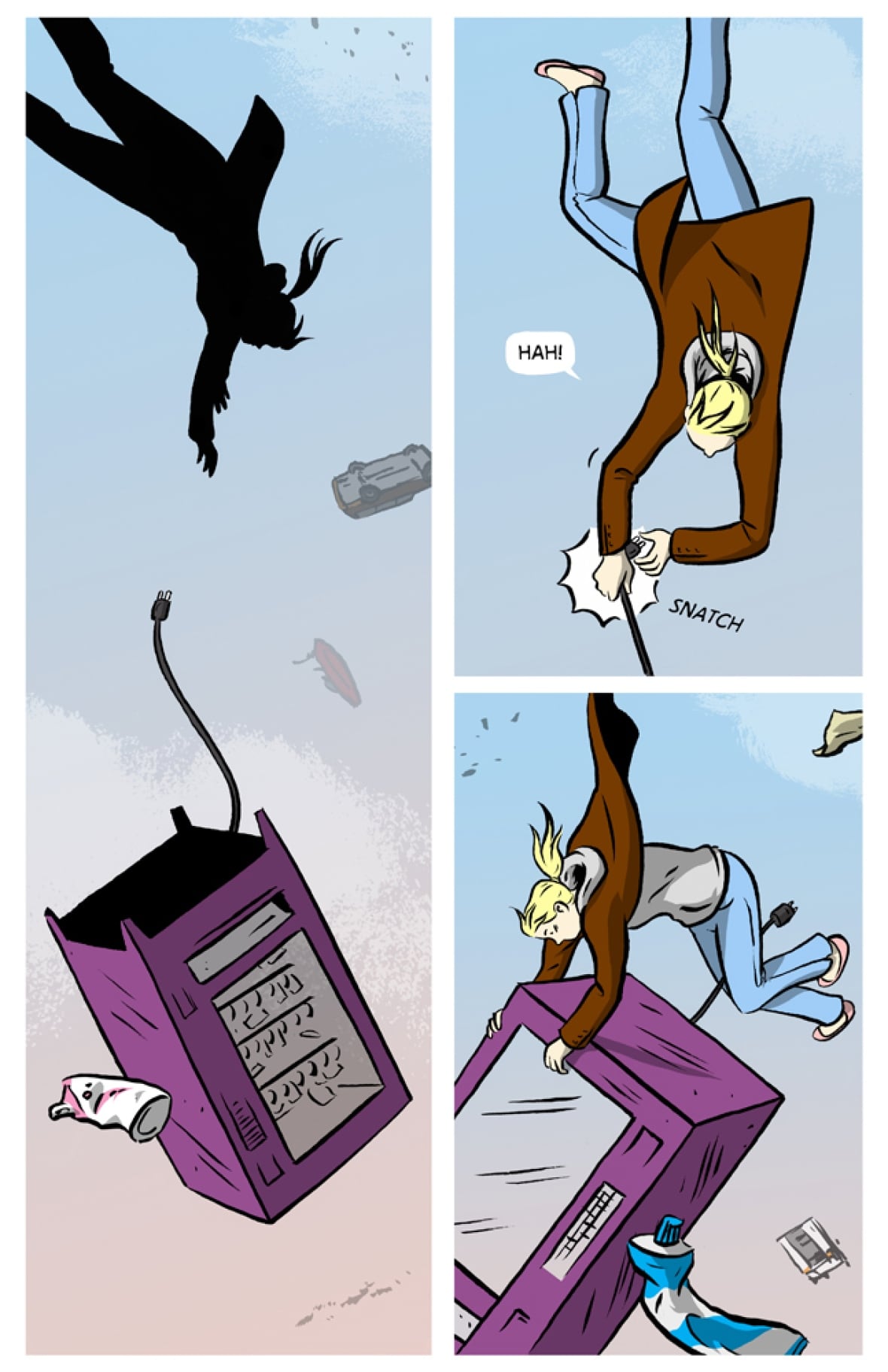
“I thought that would be an interesting premise for a book. It took me a long time to find the story behind the premise. Ultimately, I put myself in the main character’s place and imagined what would be interesting about falling forever. I make reference to the opposite of that, the Rapture, which is like rising forever until you reach heaven. A lot of religious imagery portrays people falling to hell. But I sometimes wonder how long is that fall? Does it take an hour? Or will it take forever? Or is that hell — to be falling forever? I wasn’t entirely sure how to answer that.”
Known in some circles by her Korean boy band name, BTB, Barbara Taylor Bradford (pictured below wearing Jack-Nicholson-Joker cosplay) is interviewed. Take-away info for me: she’s a Republican.

 Bookninja