And you call yourself a reader…

If you haven’t read [insert author, book, series, etc here] can you really call yourself a reader? I got this for years with a certain set of friends on Proust. Dudes, I’m not doing it. I get that you love the oeuvre and consider it a bastion of talent and taste, but I am working on other things. Sorry. Go circle jerk on Proust in some other corner of the party. I’m here and I’m talking Dune. And if you call me out on it again, I will be dropping a Cheezy in your martini glass. Any authors/books you get badgered about?

There are two enormous problems with this frame of mind. The first one is that it’s like having reading blinders. You can’t see a wider picture and you miss so much because of it. For example, when people say they don’t have many women authors on their shelves. I find this shocking. How couldn’t they? There are so many great women writers out there today. But then I see that their shelves are mostly classics and I understand. Of course they don’t have many women on their shelves, they think that only the popular classics are worthwhile. After all, they are classics for a reason. Their bookish worldview is limited, and it leaves little place for diversity. 

The other problem I’ve found is that when you judge people for the stories they read, it shames them into not reading. I have friends that don’t read because all their lives they’ve been forced to read the same books over and over. Be it 1984, The Catcher in the Rye, or Edgar Allan Poe, these are the books you read growing up. You are taught that these are the books that are worth your time. And if you like them that’s great! More books for you to enjoy! But what if you don’t? You’ll read (or find a trusty SparkNotes) to pass a grade and nothing else. You won’t find the joy and comfort of holding a book and seeing yourself within its pages. You will never find your way into books and the magic they hold.
Too many women are dying in crime fiction

This guy makes a salient point, one we often talk about in this house–never mind fiction, how do we find a show to watch that doesn’t fridge the wife in episode one or be a gruesome murder-porn-of-the-week (like that Gillian Anderson show we wanted to watch but which seemed to revel in things a bit too much)–but misses a great opportunity to talk about how things got this way. Here he comes perilously close to blaming women for it, but he pulls his hand out of the fire further down. Like similar pieces of journalism written by authors, all this leads to him talking about his own work, blah blah, but it’s a topic worth talking about, and a call I support, largely.

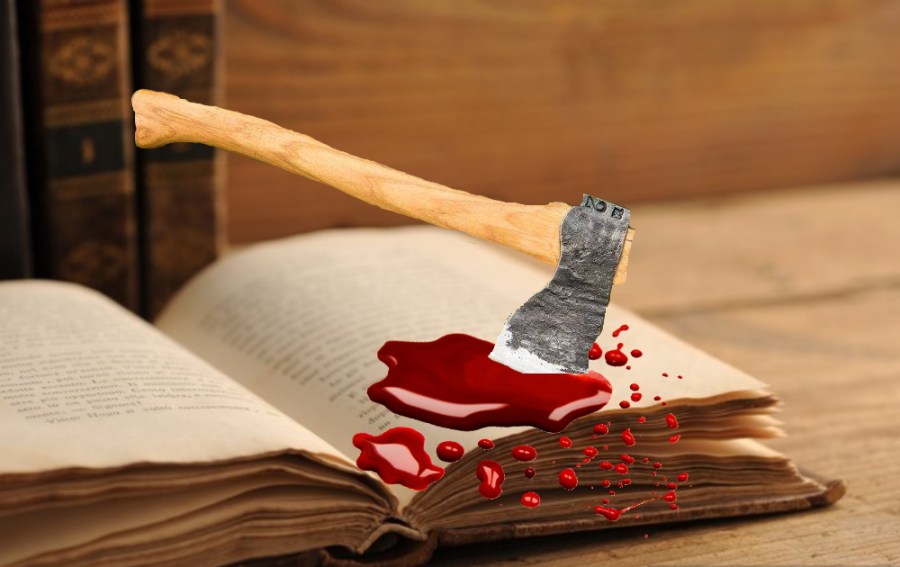
Crime writing is dominated by female authors. Yet many rely on murdered women and girls as a story engine. Once dead, the victims’ corpses, or remains, are often fetishised. Joan Smith, the critic and crime writer, says: “There was a period when a lot of crime books looked like a competition to murder someone in the most gruesome way. One had someone tying a live woman to a dead woman. I just stopped reading instantly.”

Male authors, too, [ed note: ORLY?] are guilty of lingering on the moment of death, or the sight of a female dead body. In The Intrusions, by Stav Sherez, Detective Carrigan enters a blood-soaked room where a young woman lies dead. The killer, we learn, held the dead woman up “like a shower head” for maximum arterial spatter when he cut her throat. He watched her “bleed and flail and struggle”, her blood gushing like a fountain, before carefully arranging her corpse and smoothing out her dress. Despite this splatter-porn, or perhaps because of it, the book won the 2018 Theakston Old Peculier Crime Novel of the Year.

But, beyond the herd mentality of much of the genre is a more serious issue. This fictional femicide reflects — perhaps even feeds — a wider misogyny. Nowadays feminist activists on social media are deluged with misogynistic abuse and threats for simply defending womens’ rights and single-sex spaces. When Dr Jessica Taylor, a senior lecturer in forensics and criminal psychology, wrote Why Women Are Blamed for Everything, she was deluged with abuse, rape and death threats, and her computer was hacked.

Women in the pandemic

I hope we’re all seeing and trying to mitigate how much is being dumped on women during this stressful time. Traditional gender and marriage roles/scripts have leapt back to the fore as choices have to be made about quarantine, homeschooling, work/life balance, etc. There is a woman I used to work with who I made a fake business card up for that changed her title from “Operations Manager” to “Corporate Mothering Services Manager” because the way that old-boys club worked was to reward under-performing men with promotions and then have her come in and clean up the mess. Every time something got fucked up, the brass was like, “Let’s put ______ on it.” They knew she’d not only succeed, but that she would stalwartly shoulder the burden. Why? Because that’s just what women do. Until she quit, got a better job, and left them high and dry. A year later, they still call her for advice. And she still answers the fucking questions. So much of the time, sadly, change for women comes down to how men behave and what they are not only aware of, but what they actively decide to pursue. I see plenty of exhausted women posting about this, but men need to talk about it as well. Make sure this isn’t happening to women in your homes and workplaces because of you. And talk to other guys about it as well. Actively seek out ways to support, assist, and promote the women in your life, rather than waiting for them to ask for help, because the fact is, many have been trained by the patriarchy to not.

But I digress: how are women authors handling the pandemic? Like everyone: as best they can. But research shows their careers are disproportionately suffering.

Covid-19 has created unique challenges for women. Preliminary research conducted by the journal Nature Research shows that women in academia are publishing fewer journal articles than they were before the outbreak. To get an idea of whether the same could be true for women authors in general, PW reached out to some who are also mothers to learn how the lockdowns have affected their work.

Prior to the pandemic, a study conducted by the Institute for Women’s Policy Research found that women in the U.S. spend an average of two hours per day more than men on domestic responsibilities. This is due in part to the fact that women are more likely to have partners who are also employed, to be single parents, and to have elder care responsibilities. Additionally, the division of domestic labor often comes down to who earns more, and women are consistently paid less than men.

This issue has been compounded by the pandemic.

Monday morning news

So I spent all last week with heartburn that seemed to be a bit better on the weekend but has come roaring back today. I think it means I’m allergic to weekdays. Enjoy.

On crowd-funding books

This article concentrates specifically on comic books, but I see this trend in other sorts of publishing as well: gaming, video games, regular books, etc. What started out as a model for like-minded fans to come together to basically pre-buy content (thereby ensuring no loss on the part of the creators) has skyrocketed to a money grab by anyone and everyone. Should major publishers be crowd-funding their titles? What happens to the little guys who were using this to create fringe- and counter-culture?

Crowdfunding in comics arose as a way for comic creators to fund comic projects that wouldn’t necessarily fit within the traditional comic book publishing structure, but now more and more traditional comic book publishers (as well as A-list ‘Big Two’ publishing talent) have begun using Kickstarter, Indiegogo, and others to make their projects a reality.

For some, having established publishers and creators begin crowdfunding projects feels like the old guard horning in on territory for the next generation. But for others, it’s a new distribution model – similar to the widespread adoption to the Direct Market, and later digital comics – whose time has come.

Friday get-down news

Hello, sweet freedom. Bask, frolic, prance, strut, or curl up into a ball and finally fire up the woodstove because you’ve resisted the end of summer long enough and it’s time to be warm again regardless of whether it feels like surrendering to hostile forces. It’s all up to you.

On the realism v. fantasy/spec divide

It’s time to end this nonsense push-pull between so-called realism and so-called speculative fiction. I feel like the various generations who came after me and the other X-ers will figure it out. Literature is literature. Margaret Atwood and Kazuo Ishiguro, among many others, have known this for years. Stop being a snob (on both sides). Also, I’ve never seen so many illustrative charts in one article before.

Stop making Ryan sad by forcing him to choose between his humanity and the fact that he’s a well-designed tool.

Imagine a football field of fiction. The left endzone perfectly imitates reality. The right endzone fully invents a new one. Art, being imperfect, can never reach either goal. But perhaps the left five-yard line is dotted with the dirty realism of Raymond Carver or researched historical fiction like Wolf Hall while the other five-yard line has the fantastic imaginings of Star Wars or Lord of the Rings. Everything to the left of the 50-yard line is “realism” and everything to the right of it is “science fiction and fantasy.”

This is how many readers, authors, and even critics view the terrain of literature. (And, yes, sadly many view it as a competition where we must choose a side.) Literary discourse often devolves into squabbling over the failed “realism” of stylized novels like Donna Tartt’s The Goldfinch and Hanya Yanagihara’s A Little Life or debates about whether magical realism is just fantasy for literary snobs.

Last year, an award-winning SFF author told me that non-realist literary authors like Karen Russell and Donald Barthelme were “actually science fiction and fantasy writers” while also mocking non-realist literary authors for “not even thinking through their worldbuilding.” The result is a big confused mess that leaves whole swaths of literature—fabulism, surrealism, hysterical realism, postmodernism, and so on—floating in the ether.

Realism is not a binary. It is at a minimum a spectrum. If you charted fictional realities on a football field, you’d find that work on the 45-yard “Realism” side is closer to the 45-yard “SFF” marker than it is to, say, Sally Rooney over the 8-yard line. But even a spectrum doesn’t accurately capture the vast ocean of fiction that takes our reality and heightens, stylizes, distorts, or warps it in different ways.