Woe to the fall book

Did your book get pushed a season? So did almost everyone else’s. So the efforts to avoid the Covid sinkhole pushed you into the overcrowded Hellscape that is the fall 2020 book season. If you’re starting to hyperventilate, just try to release your inner poet: none of this really matters in the end. I mean, yes, you might be looking for a new day job to fund the writing of your next novel instead of a fat advance, but welcome to the fucking club.

The main sellers since lockdown have been the big names, the “bankers” everyone already knows about (JK Rowling, David Walliams, Margaret Atwood, Hilary Mantel, et al), and the main beneficiaries have been the big multinationals – sales are up at Bloomsbury, for instance, by 28%. Small presses have struggled to survive, while lesser known and new authors have been published with little fanfare. Shopping for books on Amazon or in the supermarkets (where publishers pay for display space, an advantage independents can ill afford) simply does not allow for the serendipity of stumbling on an author one hasn’t read before. Bookshops in big city centres are still seeing low footfall and are wary of taking risks.

The books business can sometimes feel like fast fashion – pile ’em high, move ’em along a couple of weeks later to make space for the next new thing. This speed is inimical to the way in which books are actually read, and to the slow and unpredictable ways in which a culture is actually enriched. And in such a publishing climate, the window for making an impact already feels small.
From contact to contactless: on hybrid languages

Everything is about contact these days, or perhaps about trying to avoid it while trying to maintain it, if you follow. Anyway, what about language, Tiger? What happens when two peoples who speak separate languages butt up against one another? A new hybrid language forms: a contact language. Like the linguistic equivalent of a mule or a liger. The Atlantic looks at how we’re losing these rare and wonderful beasts.

When groups of people who speak different languages come together, they sometimes inadvertently create a new one, combining bits of each into something everyone can use to communicate easily. Linguists call such impromptu tongues “contact languages”—and they can extend well beyond the pidgin and creole varieties that many of us have heard of.

The origin stories of these linguistic mash-ups vary. Some are peaceful, such as when groups meet for trade and need a lingua franca: Nigerian Pidgin English, for example, allows speakers of some 500 tongues to communicate. But others were born of tragedy and violence—like Haitian Creole, Gullah Geechee, Jamaican Creole, and many others that arose during the Atlantic slave trade, when West African peoples combined several tongues with English, creating everyday languages often used among enslaved people.

Today, many of these contact languages are lost. Only 200 or so remain—and scores are at risk of extinction. Linguists and anthropologists who traditionally have focused on more formal languages are paying increased attention: studying contact languages with greater intensity and working with Indigenous groups, international agencies, independent nonprofits, academics, and others to preserve them.

This thriller has it all

Rare books and maps, theft, and… Well, that’s most of it. But it’s enough. How did $8M of rare books and maps disappear from the Carnegie Library over 25 years? I somehow picture the thief to be like the cat burglar from that episode of the Simpsons.

Like nuclear power plants and sensitive computer networks, the safest rare book collections are protected by what is known as “defense in depth”—a series of small, overlapping measures designed to thwart a thief who might be able to overcome a single deterrent. The Oliver Room, home to the Carnegie Library of Pittsburgh’s rare books and archives, was something close to the platonic ideal of this concept. Greg Priore, manager of the room starting in 1992, designed it that way.

The room has a single point of entry, and only a few people had keys to it. When anyone, employee or patron, entered the collection, Priore wanted to know. The room had limited daytime hours, and all guests were required to sign in and leave personal items, like jackets and bags, in a locker outside. Activity in the room was under constant camera surveillance.

In addition, the Oliver Room had Priore himself. His desk sat at a spot that commanded the room and the table where patrons worked. When a patron returned a book, he checked that it was still intact. Security for special collections simply does not get much better than that of the Oliver Room.

In the spring of 2017, then, the library’s administration was surprised to find out that many of the room’s holdings were gone. It wasn’t just that a few items were missing. It was the most extensive theft from an American library in at least a century, the value of the stolen objects estimated to be $8 million.

Friday news

You are alive and it is Friday. The world is bad: as it’s always been in many ways, but better in some and worse in others. Go into your weekend with thoughts of how to make it more good than bad, even if many of those thoughts are brunch- and mimosa-based. Just try to have the occasional thought outside considerations of self-medication.

Thursday news dump

Okay, so unless Joyce Carol Oates’ foot decomposes and recomposes into a hallucinatory goo-demon that would put Tetsuo in Akira to shame, I’m probably only posting what’s below today for two reasons: 1) I saw my best pal last night for a deeply satisfying round of beers on a patio downtown, something we used to do once a week, but now do about once every 6 months, it seems, meaning I’m a lightweight who’s hungover, and 2) I have a tattoo appointment in an hour and a half and need to jam my entire day into that time because as I suspect the vast majority of you know, even a small scheduled event entirely ruins the day for work thereafter.

On the joy of reading first drafts

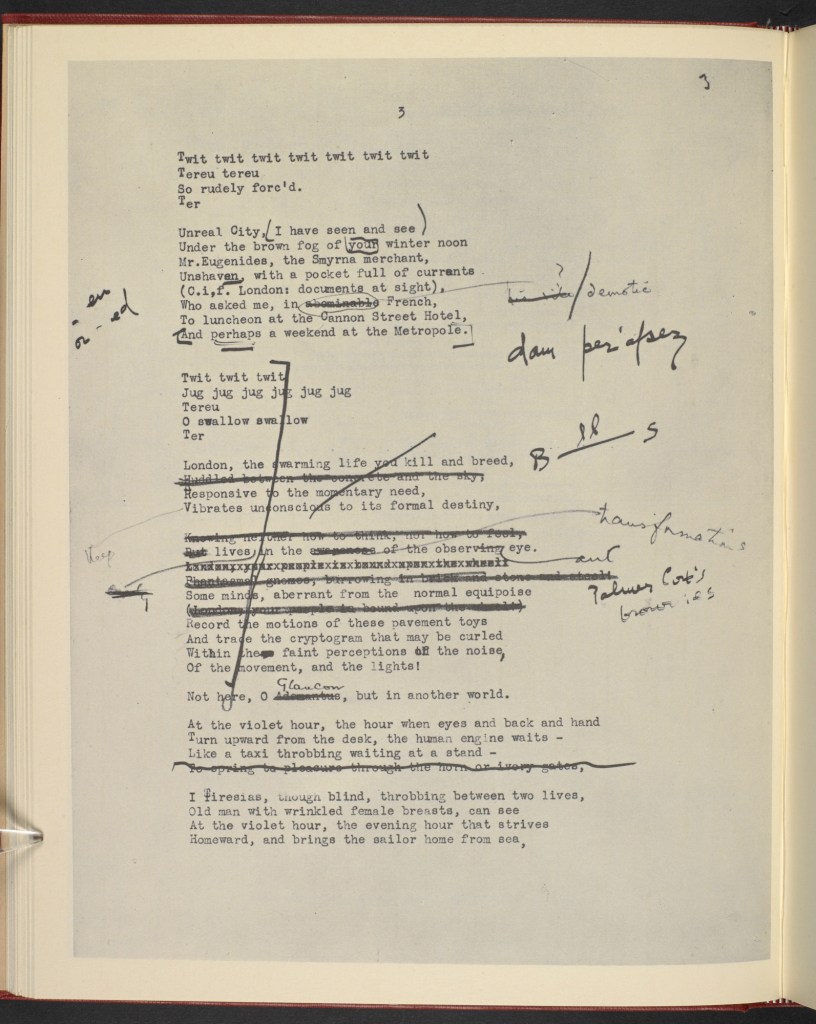
The BBC looks at what we gain from reviewing first drafts of famous works. I have a great book of photographs of the notes on Eliot’s The Wasteland, and one of my favourite possessions is Gorgeous Nothings, which is the same for all Emily Dickinson’s poems jotted onto envelope and scraps and edited by her own hand in ways that sometimes put contemporary experimentalists on notice.

The manuscripts of literary works-in-progress fascinate on many levels, from the flush-faced thrill of spying on something intensely private and the visceral delight of knowing that a legendary author’s hand rested on the paper before you, to the light that such early drafts shed on authorial methodology and intent. Sometimes, the very essence of what a writer is trying to express seems to hover tantalisingly in the gap between a word deleted and another added in its place.

Elsewhere, discombobulating differences can inspire in the reader fresh takes on even the most well-thumbed texts. Openings and endings turn out to have been quite different in their earliest renderings, and beloved characters are to be found taking their first steps bearing very different names. For instance, Gone with the Wind’s Scarlett O’Hara was originally called Pansy, Arthur Conan Doyle’s deerstalker-wearing detective answered to Sherrinford Hope, and The Great Gatsby’s Daisy and Nick were Ada and Dud.

20 percent

How long do you give a book you don’t immediately love before you decide to quit? For me (with fiction) it’s most often 20 percent. If you can’t pull me in in the first 50 pages of your 250 page book, I’m out. With Anne Marie MacDonald’s Fall on Your Knees, though, it took 100 pages before I finally got the groove and eventually loved the book. But until then I couldn’t “get” the narrator. So there are exceptions.

Much depends, of course, on hype, either from people I know or the bookselling machine at large. I’m also more inclined to stick with a book if it makes me laugh even once, which has surely knocked out some worthy, po-faced classics. I’ve lost steam after 100 pages, and I’ve quit in quiet disgust (Really? That’s how you describe an ass?) after five. And of course, these days, I’m more likely to blame quarantine malaise for my disinterest. Do I hate this book, or do I just hate sitting in this chair for the 130th day in a row? I suppose the lesson is that there’s no hard and fast rule, which has never in my life stopped me from wondering if I’m doing it wrong.

What’s it like to debut as an author this year?

Terrible. Ms. Ninja and I both have books coming out next year and we’re both relieved and frightened. Relieved it’s not this year, and frightened next might be just a version of this. This article seems to be mostly about how to get sales, which is not the primary concern of poetry, but really probably should be. If I were a debut author this year, I’d be silently crying the blues for my years of hard work. Do you or someone you know have a book out this year? Leave your thoughts and tears below.

“The toughest thing has been trying to figure out how to monetize these events,” said Jeff Martin, president and co-founder of Magic City Books in Tulsa, Oklahoma. “We get great attendance, but they’re mostly free events. And whereas before we’d have lots of book sales for some of these, that model has not quite solidified yet.”

Many bookstores have experimented with selling tickets to some of their online author events, but Magic City Books has only had success doing that with big name authors, like Colson Whitehead, John Grisham or John Waters.

“It seems like you really need to have those top-tier people to be able to do that,” Martin said. “We’re still trying to figure that out in terms of younger debut authors, or someone who might not have the same name recognition as kind of these ‘celebrity authors.’”

Even more challenging for first-time authors than the move to virtual events is the fact that so many bookstores have been closed, or open just for limited browsing.

“That creates a very challenging environment for debut authors and for publishers who publish them,” said Kristen McLean, an industry analyst with NPD Books. “It’s much harder to get attention and get in front of people from a discovery point of view when the only place they’re looking at books is online or in a mass market retailer when they happen to be there to pick up their essentials.”