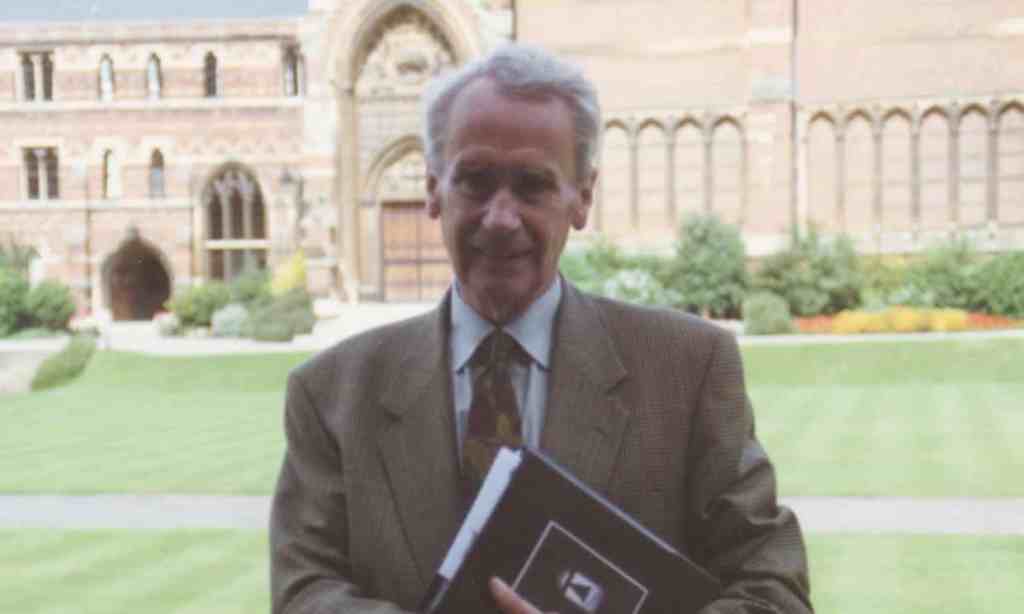
The guy who jealously guarded his father’s money minting operation literary legacy has taken one of Círdan’s White Ships across the sea to the Undying Lands. And like with most people who pass beyond the reach of men, no one seems to be mentioning that he was a bit of a dick.
from The Guardian
Although he worked tirelessly to protect his father’s legacy, he was not impressed by what he saw as the commercialisation of his work. He was famously critical of Peter Jackson’s Oscar-winning film adaptation of The Lord of the Rings. In a 2012 interview with the French newspaper Le Monde, he said: “They gutted the book, making an action film for 15-to-25-year-olds.”
Turns out not everyone agreed with giving the prize to a guy they thought held contempt for humanity. In fairness, they weren’t wrong. But I see that as a plus for liking him rather than a minus.
But with Nobel archives being made public only after five decades, documents have now revealed there were major disagreements within the Swedish Academy over the choice of the Waiting for Godot author. According to Svenska Dagbladet, the split was between Beckett and French writer André Malraux, with other nominations including Simone de Beauvoir, Jorge Luis Borges, Pablo Neruda and Graham Greene.
BookRiot has a neat piece on things overheard in local bookshops. I once had a long discussion with Janet Inksetter at Annex Books about her choice to have a shelf tag that read “Canadian Literature Ends / Poetry Begins”. Then I published just that as a found poem in one of the early issues of the groovy zine “dig.”
Bookshops are wonderful places. Obviously, they’re full of books, which is enough to make them wonderful, but they’re also full of interesting people who love books. Our kind of people, in other words. And it’s always fun to eavesdrop on those people.
This writerly critical tradition continues to flourish, both in and outside the academy. Of course, nowadays even nonacademic literary criticism (I mean criticism written for a general audience) has been shaped and influenced by formal literary study. Many writers have studied literature at university, academics and writers teach together, attend conferences and festivals together, and sometimes almost speak the same language (think of Coetzee’s fiction and academic post-colonialist discourse, Don DeLillo’s fiction and academic postmodern critique, Toni Morrison’s fiction and academic critiques of race). The rise and steady institutionalisation of academic literary criticism means that the long tradition of literary criticism is now really two traditions, the academic (Stakes¹) and the literary-journalistic (Stakes²), which sometimes flow into each other but more often away from each other. Too often, Stakes¹ imagines itself in competition with, disdainful of, or simply inhabiting a different realm from Stakes², and vice versa.
This is a great story. Indie bookseller posts pics on Twitter of the first day in 100 years of service that the store didn’t get any paying customers at all, and it trends on Twitter, resulting in £1,000 of new orders and 1100 new followers. We should make this a rotating event. Once a week, Twitter invades an indie bookseller.
…Tumbleweed…
Not a single book sold today…
£0.00…
We think think this maybe the first time ever…
We know its miserable out but if you'd like to help us out please find our Abebooks offering below, all at 25% off at the moment…. pic.twitter.com/Cn5uhYWw88
An independent bookshop that failed to sell a single book on a rainy day this week has been inundated with customers after publishing pictures of its empty aisles on social media.
The Petersfield Bookshop in Hampshire sent a melancholy tweet revealing that it had not welcomed one paying customer, probably for the first time in its 100-year history.
Within a few hours, the fantasy and science fiction author Neil Gaiman retweeted the post to his millions of followers and, as if by magic, orders came flooding in from across the globe.
“Reading changed me,” said Watson, who now works as a clerk in the prison library at Jessup Correctional Institution, “and when it did, it began to change other people’s perceptions of me.”
He hopes that a recent $100,000 grant from the Maryland State Library to purchase thousands of books for prison libraries will provide a similar morale boost for his fellow inmates.
Department of Correction officials celebrated the donation in December by leading visitors on a tour of Jessup’s library, an unimposing, carpeted room with shelves that hold roughly 6,000 books and with a circulation desk at the front. The only signs that this wasn’t a branch library were the barred windows and the customers’ gray prison garb.
Lift Every Voice is designed to enhance Americans’ understanding and appreciation of the African American poetic tradition and its imaginative range and richness. Its principal objective is to engage participants in a multifaceted exploration of the tradition, the perspectives it offers on American history and the struggle for racial justice and the universality of the power, music, and precision of its language.
I am on the side of people who live in precarious conditions wherein they might be forced to one day chew off their own arm to avoid dying under the pile of books that fell on them and pinned them to the stairwell wall. Of course, I would be very careful to not get any blood on the actual books. The arm we can get rid of. Books? Pfft. Besides joy, my litter of books might also spark a fire, but that’s how I likes it, Shelf-Nazi. (Okay, I’m not as bad as the image below, but this site doesn’t deal in subtleties.)
My office is just books everywhere. There is no order. There is no rhyme or reason. They’re every which way. There are picture books, an old Scrabble board, cookbooks, typewriters, newspapers that have stories that I’m inspired by, fan art that I’ve framed, stickers and finger puppets that kids have given me. I’ve got Spider-Man toys given to me by Marvel, my own books. I should be more organised, but I’m not an organised person. It’s a good example of how my mind works.
The only time I get rid of books is when I have multiples. I send them to schools and to people who need them. I know people say, “What’s the point in keeping them if you’ve already read them?” But they’re reference. This is my craft. These are my tools. That would be like the construction worker saying he has too many hammers.
Speaking as the NYPL’s most checked out patron of all time (aw yeah), I was interested to find out that Snowy Day, a book still on our shelves, tops the list after 125 years of loaning books and sleeping spaces to the good people and CHUDs of New York. (They also harbour librarian ghosts, but that’s a side gig.)








 Bookninja