I love Moonmintrolls

Tom Holland (who is, I believe, the charming young man who currently plays Spiderman, unless there’s a lucky writer with the same name) tells the Guardian his favourite book as a kid was a Moomintroll one by Tove Jansen. We have had so very many of these books and stories come through the house. In fact, there is a basket of books by the toilet upstairs where I insist on ghettoizing the boys’ poops that still has Moomin books in it. They’re evergreen in terms of delight. When the 17 year old was a toddler he was scared shitless of the Hobgoblin though. It was traumatic. He wanted to read the book, but not those pages. Narrative sacrificed for comfort. Like a Dan Brown novel.
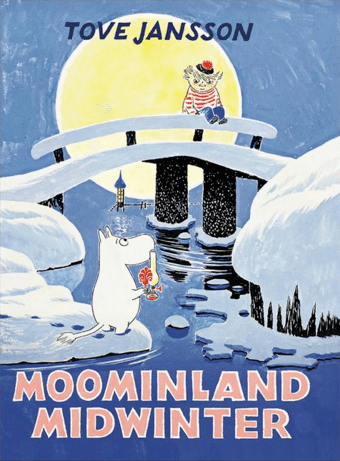
More than any other book I read as a child, Moominland Midwinter has kept company with me through my adulthood, perhaps because it serves as a study of what it means to leave childhood behind. If Moominmama is Jansson’s tribute to her much loved mother, Ham, then Too-ticky, the wise and cheerful creature who spends the winter camped out in the Moomins’ bathing-house, is her portrait of the artist Tuulikki Pietilä, with whom she had begun living shortly before embarking on Moominland Midwinter, and who would be her partner for life. Now, at the remove of decades, I can much better comprehend the dread I felt looking Moomintroll alone in his house, and the pleasure that I took in his friendship with Too-ticky, since I can recognise in them a prefiguring of the adventure of my own life: of what it means to go out into the world, to leave childhood behind, to discover new love.

Recently I have come to see Moominland Midwinter in another more disturbing light. Ever since the lockdown began, it has been haunting me as perhaps the ultimate fictional mirror held up to our current experience of pandemic. That may seem a startling claim to make, yet nothing in Defoe or Camus evokes quite so brilliantly the sheer strangeness of what we are currently going through. “I abandoned the Moomin family’s terribly hackneyed summer veranda,” Jansson wrote in 2000, “and stopped writing about what was deeply loved and guaranteed to continue the same and tried to write a book about how hellish things can be.”

What genre should thrive right now?

Lots of talk of isolation and books these days. What sorts of titles should be making it big right now? Historical fiction is the mainstay. Anything but the now and the truth, please. For me, the genre that seems most important is beer. But I am hardly a bellwether.

The genre could continue to flourish through troubled times, some commentators think, because it can help to anchor anxious readers with its strong sense of place and often quite traditional storytelling structure. “I think there could be more appetite for more classical storytelling and an emphasis on story and building other worlds, particularly past worlds,” says Emma Paterson, literary agent at Aitken Alexander. “There is a comfort in a beginning, middle and end.” Immersive and expansive historical backgrounds also provide much-needed escape: despite the arguable differences in literary merit between The Mirror and The Light and aforementioned WW2 hit Forever Amber, there are also parallels between these 900+page doorstop novels and their level of detail. Just as Mantel is known for the zeal of her historical research, so Winsor reportedly read 365 books on the Restoration ahead of Forever Amber, during her husband’s five-year wartime absence.

Thursday news dump

You know, the weather out here on this island in the North Atlantic may be problematic (it’s, like 6 degrees outside right now and there are still patches of dirty snow in my backyard), but I am thankful that I live in a country that took this shit seriously enough. And, as much as it pains me to say it, Trudeau is doing a great job. Even better is that our province, Newfoundland, has finally enacted one of the best back-pocket reasons for living here: the ability to shut down the borders to tourists, allowing us time to ride out the zombie apocalypse living on fish, berries, and root vegetables. God guard thee, Newfoundland. We have had very few new cases the last few weeks and only have a handful of active cases. Not letting people in (can you believe tourists were already showing up with their mainland breath and sneezes?) will hopefully keep things this way. So all this to say, while I will still wear a mask for our once weekly shopping trip to buy teen chow and etc., I will not fear for the safety of my vulnerable family members while doing it. Thanks, Canada and NL.

A part of this balanced breakfast?

Is breakfast the most literary of the meals? NYT asking the the hard-hitting questions we need asked right now. (Ms. Ninja can turn anything into breakfast by putting an egg on it. And it’s always delicious. When I try similar it just ends up as food poisoning.)

Breakfast is the least analyzed meal. With quarantine, it’s taken on new meaning. We’re no longer grabbing a coffee and a corn muffin from the minimart, hustling to work as if Vince Lombardi were chewing us out. Some of us are taking more care with it.

There’s a small literature of the meal. I’ve owned breakfast cookbooks I’ve never opened. (Breakfast cookbooks are always slightly ridiculous.) But there is also, if you’re alert to it, a lot to be gleaned from novels, biographies and memoirs about starting your culinary day.

Poetry’s time

Vanity Fair examines why poetry is having a day in the sun during the crisis. Maybe if we just kept the world in constant peril, poetry would … oh, wait … it’s been in constant peril for decades now. Right. Well, maybe if we kept the capitalist system of indentured servitude disrupted long enough we could… Ah, nevermind. Let the Millennial and GenZ types handle it when they come to power. We GenX types just want to get on with writing and living. Hopefully the kids will remember us as the ones who were sensible during the apocalypse and will venerate us for just doing the things that were necessary to keep… HAHAHAHAHAHA… hahaha…. wooo!…. sniff…. I’m dying here…. lol…. I almost got through that.

Poems are shooting up like roadside daffodils: Richard Brautigan’s short poem, written in 1969, about feeling bad today appears in an Instagram story; Ada Limón’s “The End of Poetry” replicates on Twitter; a “poem train” email shows up in the inbox. The world-disordering pandemic has infused new collections, written years ago but publishing now, with topical significance. Joyelle McSweeney’s Toxicon and Arachne, published by Nightboat a month into America’s fight against the novel coronavirus, depicts a world of chemical spills and pestilence. Victoria Chang wrote Obit, a collection of obituary-style mourning poems out from Copper Canyon Press, in the weeks after her mother’s death; it serves as an extended meditation on loss, and those left behind. “ I always knew that grief was something I could smell,” she writes. “But I didn’t know that it’s not actually a noun but a verb. That it moves.”

“Poetry tends to hang out at points of transformation,” says musician and United States poet laureate Joy Harjo. “People may have not much interest in poetry at all or even read it much, but when a death happens in the family, or some other grief event, or marriage, or falling in love, or falling out of love, birth—people always turn to poetry.”

Already, poets are capturing this moment. On the first day of San Francisco’s shelter-in-place order, and one week after the publication of her new collection, Ledger (Knopf), Jane Hirshfield wrote “Today, When I Could Do Nothing,” about the gentle and possibly futile gesture of saving an ant as the world begins to crumble. Carol Ann Duffy, who served as Britain’s poet laureate from 2009 until 2019, is spearheading a project called Write Where We Are Now, in which she has asked fellow poets to create a “living record” of the pandemic.

A writer’s guide to “tabling” at conferences

First and foremost, you must never, EVER turn the word “table” into a verb. Otherwise, see below. The entire concept of me going to a conference as a writer to shill my book is so utterly foreign. It’s not that I think it can’t sell books, it’s that I can’t imagine doing it. A festival, sure. But something like AWP? Just standing there begging people to come see you? Despite being invited several times to speak, I’ve never gone. Should I? I feel like it would suck the last few fucks I have to give out of me forever. Looking around at row upon row of books and publishers and writers standing there looking around desperately for a pair of eyes to look into. People wandering in circles looking for free merch. It would feel like trying to sell franchises at a warehouse conference in Etobicoke. Which I HAVE done. I never want to go there again.

There’s a fine art to selling books at a table during festivals and fairs. You’ve got to be engaging but not too pushy. You’ve got to have an eye-catching display but nothing too gimmicky. If you’re able to shed your introvert tendencies and assume an extrovert’s exuberance in public, you’ll find yourself enjoying fascinating exchanges with readers and authors around you as you autograph books and – quite likely – field invitations to appear at additional literary events.

On writing stories that don’t involve the internet

Do you miss the days when your characters’ problems didn’t involve the internet or smart phones? So does this woman over at LitHub.

On the occasion of publishing a brief collection of some of my older short stories—at the onset of the third decade of a century marked, so far, by our complete submission to market-driven technological distraction and surveillance—I am awash in a kind of nostalgia. Not for a better America. Not for my younger, healthier body and sharper memory, and not for the sweet innocence of my now eighteen-year-old daughter as an infant or toddler or opinionated eight-year-old.

What I miss is writing stories in which a life lived online does not figure—mostly. In three of the five stories in my collection The Beauty of Their Youth, the internet plays absolutely no role. In one there’s a bit of emailing. And in the final, title story, a middle-aged woman confronts the curated myths of a perfect self, both her own and those of friends from her youth, that circulate round the globe.

I remember viscerally despising email, and feeling that the nagging awareness of all the messages I needed to answer was causing real emotional harm—to both my unanswered message-writers and to me. I remember being incredulous when friends told me I had to sign up for Facebook, and then doing it, at the urging of my publisher, when I published my first novel in 2008. I remember overhearing the new president at the college where I teach—whose first order of business was to turn us into an “Apple campus” and order Macbooks for all full-time faculty and all incoming students—telling another administrator, at a meeting, that giving someone a laptop increased their productivity by 50 percent.

I remember feeling sick when he said that. I also remember thinking it would all blow over soon.

Harper Collins pumps the same-old same-old publicity brakes

Harper Collins Canada (full disclosure: the publisher of Ms. Ninja two previous novels and upcoming new one) is revamping their publicity plan for the stay-at-home world. Wait, publishers have publicity plans? Ones that change to fit the times? Wow. You fiction people must live in a strange utopia of recognition and sales. For most poets, publicity plans look like a scrap of paper torn from a Harvey’s tray liner on which someone has scrawled: I don’t know, what do YOU think we should do…?

As a result of the COVID-19 pandemic, physical bookstores have closed – which has led to a decline in book sales. Literary events are being cancelled or moving online. But at the same time, there is clearly an appetite for reading, as many Canadians stuck at home find themselves with more time on their hands and a need for entertainment.

HarperCollins Canada saw a problem – and an opportunity. Its marketing and publicity team worked to come up with ideas to help their authors and bookstores make up for the loss of launch parties and events held at bookstores.

“At the beginning of this, it really did feel like the Wild West,” says Lauren Morocco, publicity director. “Publicists, I like to think that number one in our jobs, we’re problem-solvers. But it really has been everybody brainstorming, heads together, on what we can do and how we can do it.”

On math and poetry

Can math create poetry? Seems to create everything else, so why not? This one goes out to the experiment-poet readers. Sorry: reader.

When I put together my page-a-day calendar, published by the American Mathematical Society (why, yes, it is still available; thanks for asking), I knew I wanted to include a healthy dose of poetry. I love seeing poets and mathematicians play with mathematical ideas in settings that are not governed by the rules of theorem-proving. When I was poking around for poems that would work well for the calendar format, I was struck by this poem by University of Connecticut mathematician Sarah Glaz. I used it for the January 13 page, naturally enough.