RIP: Handwriting

Is handwriting a dead language?
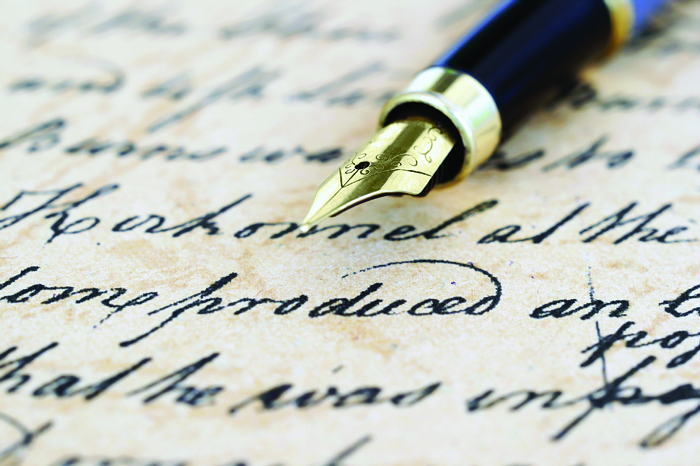
Is it time to compose an elegy for handwriting? Anne Trubek thinks so – indeed, hopes so. She deems the ability to form a cursive script “merely emblematic”, and dreams of a future in which the school curriculum will include it only for art classes. It will remain solely the domain of calligraphers such as Patricia Lovett, who is herself probably Britain’s best-known practitioner, teacher and advocate. Lovett’s latest book is a gorgeously presented survey of the work of masterly scribes from the third century AD to the twenty-first, culminating, appropriately (and with no false modesty), with her own work. Though Lovett would undoubtedly baulk at such a description, her volume constitutes, in Trubek’s logic, an alluring swansong of an “antiquated” skill.

If script is dying, it cannot complain that its day has been short. Its solitary reign may have been ended by the printing press, but it lived on as a citizen in the new republic of letters: official records, account books, botanical drawings, not to mention works for private circulation and personal epistles, continued to be produced by hand for centuries. Then came the typewriter, but even its keys could not strike the death knell of handwriting. Perhaps that machine’s close descendants, the keyboards of our computers and their avatars on our screens, are administering the coup de grâce. Perhaps.
Today in non-palpitation news

…and here you thought it would be nuclear war…

Well, we’re through the first (agreed-upon) week of the apocalypse. The ‘Rona has gripped the world in its filthy fist and given humanity a shake. Get your shit together, you fucking idiots, it says. That’s right, Humanity is a drunk who has hit rock bottom and is currently vomiting the entirety of a Hooters wing night into a gutter outside a rural strip club in Texas. We can’t go on like this. Some hard choices have to be made. We need to get our lives together. Let’s take the weekend to reflect on our shame and gather back here in a few days. See you Monday, if there still is one.

Is the engine of fiction physics-based?

What can physics teach us about fiction? This will either go over super well or very poorly with the sort of writer who believes they’re channelling a muse or whatever… “Imma just write until I find the characters and then the characters will tell me what the story is, you know? Here, have a crystal to rub on your forehead to release your creative self from its prison.” No thanks, I’ll stick with mushrooms.

As a teacher, I see my students grappling with this difficulty on a daily basis. Their small successes (“Great dialogue!”) are overshadowed by all the parts that aren’t yet working. And there are so many parts, so many ways to not be working.

This is what got me started thinking about simplifying an approach to craft, or rather, trying to understand what craft elements encompass which other ones as a way to focus on manipulating the fewest elements of a story to receive the largest payoff. My answer came from another, highly-complicated field: Physics, specifically, Albert Einstein’s Theory of Relativity.

In layman’s terms, the Theory of Relativity proposes that the measurable properties of time and space aren’t actually as fixed as we perceive them to be. They’re subjective. In our real universe, time and space flex, expanding or contracting relative to moving objects. I began to see parallels between the time and space of the physical universe and the time and space of the fictional one. What if time and space were the only two properties the writer sought to control? Would the universe of craft choices become less overwhelming in their entirety?

On constraint

When I teach my intro poetry classes, I focus on form — mostly traditional ones, as a way of filling the new poet’s toolbox with useful items: meter, rhyme, lining/enjambment, voltas/cuts/turns, etc. But when I get into the more advanced classes, I assign “constraints” rather than forms, even though some of the constraints area really just creating their own new forms. This women did a Perec and wrote an entire novel without the letter O in it and here she talks about how her own self-imposed constraints helped her get it done.

It seemed like building with Meccano minus the nuts and bolts to secure all the pieces. But as the writing progressed, new thoroughfares opened up where I’d expected impediments. A simple descriptive sentence such as “Sunlight shone through the windows” became “Sunlight blazed in the single-glazing”. The constraint made me work harder to look beyond obvious ways of expressing things. I had to slow down and consider my medium. I had to weigh each word.

Writing with no O started out as a method of subtraction and distillation, but it grew into a form of play. The dictionary was indispensable. Much of my writing time was spent looking up words, their etymologies, and, of course, scanning for O-less synonyms. It brought me back to the days of amazement as I observed my daughter learning language when every word was a kind of revelation. I remember one summer day cycling with her on the back of my bicycle chattering away to herself while I pedalled toward the local farm. At one point she sing-songed, “Li-am in the fil-lum mu-se-um. Mummy, that rhymes!” She was completely tickled with what her tongue had stumbled upon. What a singular state that time of life is, when language is a plaything, a novelty, when it’s not yet second nature.

…and the sun became black as sackcloth of hair, and the moon became as blood…

Gooooooood morning, Apocalypsia!

Social media vs publishing

We tend to use the word mob for “the other guy’s” cause and “protesters” for our own, but they work either positively or negatively (and sometimes both) in relation to our books. How does social media, with its varied trolls, mobs, and troll mobs, affect publishing?

Hachette Australia publishing director Fiona Hazard, who says she would not have distributed Allen’s memoir here, says good publishers assess public sentiment. “The size of someone’s social media profile can play a part in publishing decisions, including the way they are seen in the wider community. So if someone is writing on integrity and honesty and then found to be dishonest that will have an impact.”

And if there’s adverse reaction on social media? “When we decide to publish a book, we consider all the angles and will stand by our authors,” she said. “Sometimes, however, people can do the wrong thing and reputations can be damaged. In these instances, we must deal with the fallout on a case-by-case basis.”

Publishers, she points out, have to be aware of cultural sensitivities and to seek sensitivity reads where appropriate.

On bringing short fiction back into your reading schedule

You don’t have to wait for May and (sometimes blogger) Steven Beattie’s short story extravaganza at That Shakespearean Rag to get these wee nuggets of narrative goodness back into rotation. You have so much time RIGHT NOW! Yay to this… you know, except the part where the authors never got a lick of cash because all the stories were photocopied.

I used to read a ton of short stories. My love of short fiction grew out of the many creative writing classes I took in my early 20s. I didn’t finish college, but living outside Boston as a young adult, I took advantage of the many workshops on offer, and took as many writing classes as I could afford. We read a lot of short stories in those classes, and I fell in love with story after story.

I started filling an old binder with the photocopied printouts of stories we read in class. Writer friends recommended stories, which I’d track down in the library, copy, and add to the binder. Of course I’d read short fiction before, both in and out of school. But during those years in my early twenties I was hungry for short stories in a new way. I couldn’t get enough. I loved their quickness, how they could sharpen a character or an emotion down to its essential truth and lay it bare on the page.