Stop using dictionaries to support your pedantry

Dictionaries are meant to explain and define current use in a language, not prescribe it.
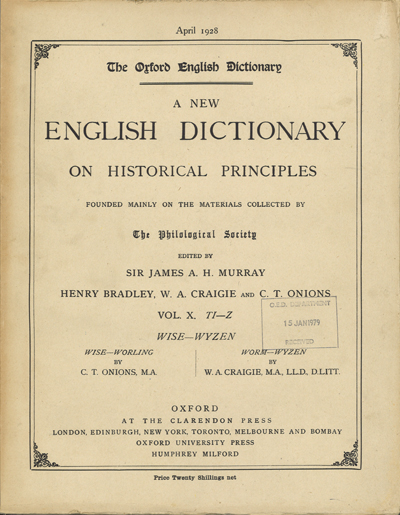
Takes a Murray to get it done.

Another kind of case has emerged in recent days. Tottenham Hotspur has shown the yellow card to the Oxford English Dictionary for its new definitions of the words “yid” and “yiddo”. While the dictionary records both words as usually offensive terms for Jewish people, it now also describes them as nicknames for Spurs supporters, noting that the fan-directed usage is “originally and frequently derogatory and offensive, though also often as a self-designation”. The club has issued a statement saying that it has “never accommodated” use of the “Y-word”, and considers the definition “misleading”.

Every time people say that a word or meaning “doesn’t belong” in a dictionary, lexicographers sigh a little. Dictionary writers share a vocation to record a particular language as it is used rather than how anyone, whether Peta or Spurs, would like it to be used. This is especially true of the OED, which is designed as a tool for the historical study of the language, recording evidence of changes in English words and meanings over the past thousand years. It’s worth noting that at this point Oxford Dictionaries has included the “Spurs supporter” definition of the Y-words only in the OED, a subscription-based service intended for those engaged in historical and linguistic research. It does not appear in its web-searchable online products, which are designed for everyday use by people learning or using the language.

Solving reading reluctance in kids with….

Availability and choice. Huh. Who knew that humans might want to govern their own interests and identities? Turns out, a robust in-class library (as opposed to the room down the hall full of computers), gets kids jazzed.

“I only read books that teachers made me read,” the sophomore said. “I never found them interesting, words without pictures.”

Now Baldwin is a voracious reader, plowing through almost 15 books so far this school year.

She said Guevara sparked her love of books because he has an extensive in-classroom library with hundreds of books — fiction and nonfiction. He also gives his students 10 to 20 minutes of free reading time at the beginning of each class, which he celebrates in a series of Facebook postings he calls “Students Reading Choice Books.”

Good news

Note: not a Christian magazine left in your mailbox when you wouldn’t answer the door for those Jehovah’s Witnesses.

Satire on the ropes

An excellent question: how do you ensure you’re punching up, as you should be with satire, when no one can agree on which way is actually up? Satire is really feeling it these days, what with the news appearing to be satire and satire being more reliable than the news. (TLS sub req to finish.)

Depending on whom you ask, it is either the best or the worst time to be writing political satire. The best, because the news itself is doing half the work for you by inhabiting the uncanny valley between real life and an Onion headline; the worst for exactly the same reason. If it is a satirist’s job to draw out what is ridiculous in current events, today’s news cycle can either make that seem too easy, or overwhelming – comedy writers like me can often feel a bit like a dog trying to chase six tennis balls without dropping the one in its mouth. Add to that the pressure to be original, at a time when everyone from Hillary Clinton to Greggs the bakers are taking shots at the powerful on Twitter, the fractious nature of audiences and the fact that by roasting their enemies on social media and appearing on panel shows powerful targets are increasingly using satire for their own ends, and it’s easy to see why a satirist might start to suffer from an identity crisis.

When does your influenced art become plagiarism?

Can your stealing from others be its own art?

YOINK!

Much has been made of late of plagiarism—or playgiarism, as Raymond Federman calls it—as a valid literary resource in a world progressively more awash in text with each passing day. What I’d like to discuss is what I’ll call a sort of structural plagiarism, just as frequent and certainly at play with those mentioned above, but less recognizable per se than lifting and sampling in the form of quotation—whether cited or not—as a means of expression.

Just another newsy Monday

Are libraries the pipeline to reconciliation?

Libraries are reporting a spike in interest in Indignenous stories. Who would have thought: it turns out when you give Indigenous authors the same front table exposure as everyone else, the books move. I want to say that the Canadian people are interested in the Indigenous perspective, but the cynic in me says it’s not Canadians, but Canadians who read. And that in turn makes illustrates how much of this is an education issue. The critical thinker wants to learn more about what it doesn’t understand. The non-critical thinker wants to leave awful comments on CBC articles. Hey, Justin, do you hear this? Who’s going to vote for you in the next election? The commentors or the readers? Perhaps neither if you keep choking the life out of our Indigenous brothers’ and sisters’ lands.

from CBC

At the Toronto Public Library, collections manager Michele Melady says she has noticed a spike in interest for books like The Marrow Thieves by Métis author Cherie Dimaline and Seven Fallen Feathers by Anishinaabe writer Tanya Talaga. 

Anna Comfort O’Keeffe, publisher at Douglas & McIntyre, says eight of her company’s top 10 books are written by Indigenous authors like Richard Wagamese. 

“That’s what people want to read right now,” she said. 

O’Keeffe says there has been such a proliferation of Indigenous writing that BookNet Canada, which serves the book industry, is revising international standards to include new classifications like Indigenous poetry. 

Canadian book day?

This guy is working on a new holiday for celebrating Canadian books. It warms the heart to think of all these families settling down together on February 19 to read a tried-and-true Canadian classic like Beautiful Losers or The Bear.

If writer Eric Walters has his way — and there’s every indication he will — schoolchildren across the country will be picking up a book written by a Canadian on Feb. 19, and helping to celebrate a brand new national day.

The idea is simple: encourage families, kids, teachers to take 15 minutes out of their day to read a Canadian book. To help make it easy, schools, libraries and bookstores are hosting activities and events to put Canadian books in their hands. What sparked the idea is a bit more complicated: a shocking drop in the sales of Canadian books.

In December 2018, the More Canada report had just been published. It found that Canadian-authored books then represented just 15 per cent of book purchases — they used to represent 26 per cent. It also found that there were fewer publishers publishing Canadian books and that sales of Canadian books had declined by 44 per cent over the previous ten years — and that Canadians weren’t even sure if they were reading a Canadian book, partly because of online retailing.

Fight the power

Not of love, of the Amazon algorithm. Two articles here, with the first being a Guardian piece on booksellers who are trying to beat the algorithming of literature with consultations and subscription services and the first employee of Amazon, basically a second founder, says what the whole damn enterprise has become scares him.

In an interview for a new PBS Frontline documentary about Amazon viewed by Recode, which airs February 18, Kaphan said the company’s rise to power has left him conflicted.

“On one hand I’m proud of what it became,” Kaphan told the documentary’s host, James Jacoby. “But it also scares me.”

“I think not all of the effects of the company on the world are the best,” he added. “And I wish it wasn’t so, but I had something to do with bringing it into existence; it’s partly on me.”

Friday news dump