And I mean that in less of a Celine Dion way and more in a Huey Lewis and the News way. Listen, I dislike this retail-buying-cycle-focal-point-disguised-as-a-holiday, not because I dislike love (I’ve learned all about it the last 10 years and it’s pretty dece, let me tell you), but because I hate being lied to. I also hate demonstrably participating in things. It makes my inner mohawk ache. So who should we blame for this yearly nonsense called Valentine’s Day? A goddamn poet. Of course. Chaucer, you fuckwit, look what you’ve wrought.
So, story time: back in the aughts, I sat on a national poetry award jury and tried to champion Zong! by M. NourbeSe Philip. I was dismissed out of hand. I mean, we barely discussed it. I came to the table with a list that comprised both traditional and experimental forms, and I honestly thought that if any of my “experimental” choices were going to make it on the shortlist, Zong! would be the one. It was a difficult read for people brought up more traditional work, no doubt, but once you got the music of it, it was utterly compelling. You just couldn’t expect to get that music first time, with an untrained ear unused to the cadences and language flexibility within. So, no dice. Don’t get me wrong, the list ended up with some great names on it, but the jury arguing seemed to be between an entrenched establishment deal of poetry and me (and the gods know I’m but an armchair champion for any school at the best of times.) So, I’m glad to read this Walrus piece that explains a bit of why, and then to find this CBC article on Philip cleaning up, internationally. Also a Puritan essay linked in the quote below. High time.
Philip describes herself as a “disappeared” writer who has paid the price for her activism with her erasure from Canadian literature. In a recent essay published in The Puritan, Kate Siklosi expertly demonstrates this disappearance and the “archive of silence around Philip and her work in Canada.” While many of her contemporaries have taken up comfortable positions as creative-writing instructors or editors in publishing houses, Philip has yet to find prominent footing in the larger CanLit scene. Outside the country, she has been given the Casas de las Américas prize and a Guggenheim Fellowship among other international honours, but she has never received any major national literary award at home. Her 2008 collection, Zong!—about the 1781 murder of Africans thrown overboard on the orders of a slave-ship captain—was mostly ignored by Canadian critics despite being praised around the world.
Given Philip’s polemicism and her poly-vocal experiments with form, it might not be surprising that she would be seen as an outsider to the tonier CanLit communities. What is surprising is the extent to which she is also missing from the contemporary debates that have transformed CanLit. Philip’s history of disruption is directly relevant to our current discussions over cultural appropriation, antiblack racism, and exploitation in Canadian literature and publishing. Yet it’s hard to find major essays on the current state of CanLit that make reference to her work, she has been notably absent from panels discussing the topic, and isn’t a contributor to Refuse: CanLit in Ruins, the new anthology of criticism on the “raging dumpster fire” that has consumed the Canadian writing scene.
Tomorrow is St. Valentine’s Day, which I call “Halloween for Lovers”. It’s a religious day that was coopted by big business to sell you more shit because January and February suck in retail post-Xmas. Regardless, people seem to go in for it, so half the articles out there right now are blabbering about romance, etc. My concession to you all is one article: this woman was courted by a smoothie who made his move through her favourite novel. Aw, isn’t it …lovely… how closely courting and stalking are? It’s like a Sting song.
This sort of thing was still in circulation when I was a kid, and yet some people still argue about the existence of the patriarchy
“Hello, I’m Mark,” he said warmly, extending his hand with (I came to learn) characteristic frankness. “Who are you?”
“Not now,” I replied, batting the hand away with (I must insist on this) uncharacteristic curtness. I was tired. I was wary. I had recently been dumped by a man to whom I had devoted considerable attention, and I wasn’t ready for a new entanglement, let alone conversation, with a stranger.
The encounter would have ended there had Mark not demonstrated unusual and, given the circumstances, inexplicable persistence. He obtained my email address from a mutual friend and energetically deployed it. Eventually I found myself having lunch with him, and of course we talked about books — terrain we’d already established as common ground. We exchanged the names of our favorite novels and joked about the fact that he had not read mine, nor I his.
The next day, a copy of his arrived in the mail: “Vineland,” by Thomas Pynchon. And then, a few days later, came a crisp handwritten card containing a passage from mine, Henry James’s “The Portrait of a Lady”: “There was such a thrill even in the preliminary hovering.”
When that card was followed by an invitation to brunch, I didn’t hesitate to say yes. There were more meals after that, along with, at crucial intervals, handwritten cards featuring lines from my favorite novel.
Former editors of big glossies dish on what a shitshow that place is. The magazine is dead, long live the magazine, etc. Lots of gossipy drug stuff etc in here. I kind of skimmed it to be honest, but the parts I read were sort of fascinating. My favourite quote is somewhere at the top where they call it the place that puts “the loss in glossy.”
Editors of glossy magazines had status then because their products seemed important. People went to newsstands or physical mailboxes to find bound pieces of paper dropped by postal workers that would tell them who and what was cool, giving them topics for cocktail-party and water-cooler chatter.
Portable phones were these whiz-bang things that folded shut and were tucked away in pockets and expensive “It” bags.
The early and mid-aughts were the Roaring ’20s of magazines, with the looming economic recession not yet imaginable and the disruption of digital media not considered by publishing executives, so infatuated with their pretty print pages and the huge margins that print advertising delivered. No matter that their one real job was to have their fingers on the pulse of What’s Next.
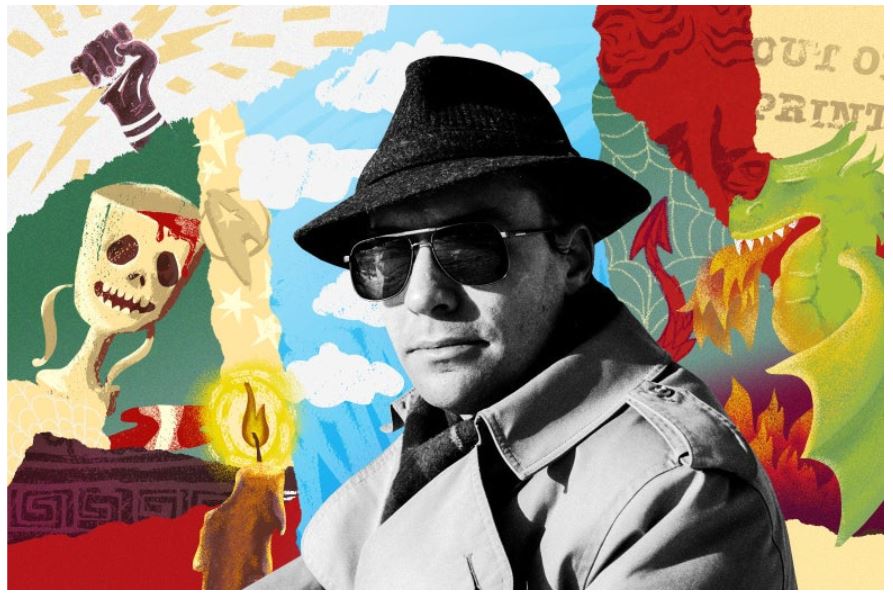
The SFF author we should all know about but don’t. Turns out when you don’t stick to one thing, you end up destitute, forgotten, and largely ignored. Eep. And here’s me with my ADHD. My corpse will be in the livingroom, laid out on the recliner. Please have it stuffed and mounted in the corner in a pose of vague disapproval to remind the children to do better in life than I did.
Image from Slate article
“He would make art in the most surprising places,” Gaiman told me. “Once he wrote a short play based on the invitation and directions to my annual Guy Fawkes party. There was a typo, and he took that as the grounds for a play.” When Ford visited his editor Teresa Nielsen Hayden at her office at Tor, he would scribble short parody poems of the documents on her desk and leave them for her to find. “Life was not long enough,” she recalled, “for Mike to do all the stuff that he would think of to do.”
“He could have had a more successful career,” Patrick Nielsen Hayden, Teresa’s husband and Tor’s editor in chief, said, “if he had been more disciplined about his writing” and stuck to one genre, or written a series. “But Mike wanted to write what he wanted to write.”
Never seen an article like this before, I’m glad someone is finally asking the question. But seriously, I think the average person is like a toddler when it comes to issues about the importance of the arts: they need to hear the message more than a dozen times before it sticks. So I don’t really resent these sorts of articles. I feel they’re all part of a slow, steady effort to raise the average person out of toddlerhood and up to a level nearing a border collie.
Today, again, we ask the perennial question: Does poetry matter at all?
It’s hard to figure out poetry’s worth when there is a hierarchy of “va
It’s hard to figure out poetry’s worth when there is a hierarchy of “values” hanging over our heads determined not by nature or skill but by powerful men in the publishing, media, and political industries — entities that are about making money. I’m not talking about family values or cool traits. I’m talking net worth, the bottom line: “If it don’t make dollars, it don’t make sense.”
Sometime after the fourth century, an unknown transcriber of the Mithraic scholar Lactantius Placidus accidentally conjured into history a demon named Demogorgon. Writing in the margins of Placidus’s commentary on Statius’s Latin poem Thebaid, the transcriber turned his attention to a line concerning “the supreme being of the threefold world.” By way of gloss, the scholar noted that Statius had been referring to the “Demogorgon, the supreme god, whose name it is not permitted to know” (even while Placidus apparently knew it). Etymologically the provenance of the word is unknown. Aurally it reminds one of the daemons of ancient Greek philosophy, that indwelling presence that acts as a cross between consciousness and muse; a terrifying sounding being, with its portmanteau connotations of both “demon” and of the serpentine-locked “Gorgon.” Most uncanny of all is that no reference to the “Demogorgon” appears to exist before the Placidus’s marginalia.
Well, the town here is shut down again, b’ys, so my morning has been a lazy one of coffee and granola and looking out at what is surely one of the front lines of the Climate War. I’ll try to leave a GPS running so the helicopters know where to land to drop off the rescuers with shovels.
Can one of you younger types gif-up the video below up so we can meme the everloving fuck out of it? Please? Thank you, faceless millennial. Know that you are doing good work:
It’s always been a story, we’re just reporting on it more now. Authors, particularly white male authors, have often been (and continue to be) shitty people. The spec community, like the fan community, seems to EXTRA draw out the worst in some people. (In fairness, the very air itself seems to draw out the worst in some people these days.) But hopefully change is afoot. I’m glad Jeanette Ng stood up and said this. Cram the incel/bot-led fanboy keyboard-jocky babies into a box and set it on fire, I say.
Painting by Paul Vermeersch
…when Jeanette Ng – who had been awarded, by popular vote of the attending and supporting members of the Convention, the John W. Campbell Award for Best New Writer – used her acceptance speech to question, in a rhetoric of biting righteous anger, the award’s continuing to be named after Campbell. True, his editorship of the magazine Astounding Science Fiction (later Analog) between 1937 and 1971 had seen him foster the careers of many important writers, but on the other hand he used his editorial platform to push crankery, pseudoscience and vicious racial prejudice.
“[Campbell] is responsible”, Ng said, “for setting a tone for science fiction that haunts this genre to this very day. Stale, sterile, male, white, exulting in the ambitions of imperialists, colonialists, settlers and industrialists.” The hall cheered her wildly, in a way it would not have even a decade earlier – perhaps partly because the authors Campbell fostered, the sorts of story he encouraged, have ceased, for younger readers, to dominate SF’s assumed canon.








 Bookninja