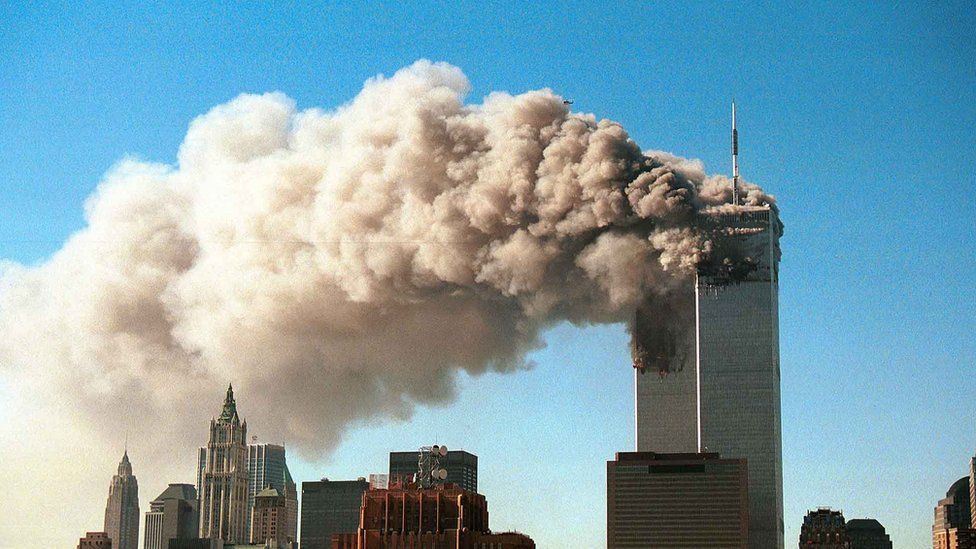
Here’s a strange and interesting piece on how 9/11 changed things for writers. Having been there that day right beside it when the first tower came down, and having watched 19 successive anniversaries and dreading the 20th to come, I wasn’t expecting this to the be first big article I’ve encountered on the whole thing. Did it change the way I write? Maybe? I don’t know. I’m glad to not think about it most of the year. Maybe it’s in there, percolating in my lizard mind, subtly nudging me towards the dire and dour. Or maybe that’s just my Scots-Irish heritage. Hard to tell.
We could speak of dread, hardly a new theme in our fiction, which flowered anew, along with a sense that while we were visible, our enemy (or enemies) was not. The English novelist Ian McEwan, the author of “Saturday,” one of the better novels about life in the years following 9/11, commented in the aftermath that “American reality always outstrips the imagination. And even the best minds, the best or darkest dreamers of disaster on a gigantic scale, from Tolstoy and Wells to Don DeLillo, could not have delivered us into the nightmare available on television news channels yesterday afternoon.”
Cormac McCarthy’s postapocalyptic novel “The Road,” he has said, was directly inspired by 9/11. Novels like Emily St. John Mandel’s “Station Eleven,” in which a fictional flu epidemic has devastated the world, and even Whitehead’s zombie novel “Zone One,” landed with fresh force. (Zombies became, in novels, film and television, something like national mascots.) There was a sharpened sense that the unease would never end.
No, probably not — a this article states, setting it up as the “side-hustle” of publishing. But from Rushdie saying he wants “a slightly more complex relationship with readers” (dude, I would argue that your relationship with readers is more than adequately complex) to everyone with a built in audience who wants to more control and possibly to publish things that hover somewhere between tweets and books, it’s apparently the way to go right now.
Writers flirting with the Substack idea would be better seen, says Lawson, in footballing terms: they are probably going out on loan from their existing publishers, not transferring for good. He doubts that big names will turn their backs on traditional publishing.
“If you take crime fiction, which sells hugely now,” he says, “the big names have long-established series, so if Substack signed up, for the sake of argument, Ian Rankin, Peter James and Val McDermid, they might get a new book out of them but they couldn’t have their backlist. And that’s where the value is for a lot of crime authors.”
That said, Lawson thinks readers would definitely shell out for a Substack subscription if it was the only way of reading their favourite author’s newest novel. But he wonders if the model is sustainable.
Parasocial? Is that more or less than social? Cause I can barely handle social. It took me the last 25 years of writing to realize that collegiality doesn’t equal friendship. That’s 25 years of being too earnest and getting burned by assholes, people. Don’t tell me there’s a whole other level to this. Wait, is this about obsessive fans thinking their your pal? Whew. Don’t have to worry.
Parasocial interaction (PSI) was defined in 1956 as “a kind of psychological relationship experienced by members of an audience in their mediated encounters with certain performers in the mass media, particularly on television.” These days, I’d argue that social media has taken PSI one step further and many authors with public-facing social media presences can also find themselves in the role of those performers or recognizable public figures as defined by Horton and Wohl in 1956. Most people may not see anything wrong with a little bit of minor fame, but issues arrive when readers and audiences begin to see public figures as real people they know personally. How we treat strangers differs from how we treat people we perceive as friends, and this is where boundary crossing can arise.
FTR, the first stranger who finds out I’m a poet and tries to connect with me by saying they have attended a “poetry reading,” the one on Amazon, is going to end up with Ex-Lax dropped in their coffee when their back is turned;
Sheila Heti talks trusted first readers… I have two… then after that, a circle of second readers, each with a different aesthetic and absolutely zero compunction to coddle me;
As someone married to a thriller writer, I have been relatively lucky to have my quirks and mannerisms appear mostly as aspects of the good guys. Mostly. That said, I am married to a writer and I am getting what I asked for. Stories of mine get YOINKed all the time — mostly little details or interesting tidbits… the stuff that feels like real life. In fairness, ideas and expressions of hers also appear in my poems. That said, I have this one piece of advice for you as someone who knows a writer: if you tell them a story WITHOUT saying, “Now, this isn’t for use in a novel” first, I don’t know that you have any moral avenue of objection. It’s what they do, and you knew that going in, and their experience of hearing the story without being told it’s not for use in their art is really just their experience of hearing something one day. We do it all the time, in all artistic genres. God knows, some science article comes up with a vaguely poetic image like “wolf moon” or some shit and two years later all the lit journals are filled with crappy poems about the wolf moon. Because what writers do is process reality and hand it back to us for context that we can use as decoration for our minds. Anything they hear or see is just another part of their day tucked away for future use. But I do think most writers will respect a “please don’t use this” request. Beyond that, everything said and done in and around them is fair game. So beware, is what I’m saying.
Contemporary entertainment is a hall of mirrors, an endless flow of simulacra: reality shows, biopics, documentaries, Instagram posts, Youtube vlogs. Podcasts and docuseries and movies process the same real-life events (Tonya Harding, the O.J. trial, Theranos), responding to one another, building on one another, until the metanarrative is part of the entertainment. I guess it is no surprise, then, that our fictionalized characters have starting launching protests about how we’ve used them. A woman named Alexis Nowicki recently wrote a Slate essay outing herself as the inspiration for the viral short story “Cat Person,” and Amanda Knox, who was falsely accused of murder by Italian authorities, wrote an Atlantic article about a movie that (very) loosely transposes her story. Tom McCarthy, the director of Stillwater, did acknowledge in a Vanity Fair interview that his movie was “directly inspired” by Knox’s case. I still can’t decide if this was all marketing — McCarthy trying to stir up the true-crime audience and situate his film amid the flow of Amanda Knox content — or naiveté, an artist assuming that people will understand that inspiration is about the spark of an idea, not the act of appropriation.
I just got back from a week in the wilderness of Gros Morne national park where I attended and spoke (twice!) at the Writers at Woody Point festival — a magical spot among the mountains that I very much love returning to every year.
In 2020, the venerable festival (a favourite among writers simply because of how beautiful it is there and how frigging well they treat you) was all-online, but this year they got the go-ahead to do it live, with some changes. So there was reduced capacity at events, distanced seats, etc. That said, much of it was still indoors, and people were hugging and shaking hands (a thing I haven’t had to endure for 18 months). In many ways it was a relief, even for someone like me who doesn’t like public things. That said, it was also deeply strange and uncomfortable at times.
Our mask mandate in Newfoundland ended a couple weeks ago and the Delta variant has yet to take hold here. Further, we’re doing quite well with the vaccine rates and myself and all my family are double vaxxed, so I shouldn’t really worry, right? Some people wore masks anyway, myself included, but as the week went on, more and more masks got forgotten in pockets or left in rooms, and the world did not end. (Well, we’ll see if it ended in about 2 weeks, I suppose.)
That all said, as someone who is already uncomfortable in crowds but who is also good getting up in front of one when he needs to shill a book, I found myself constantly looking for excuses to leave (moreso than usual) and head off to a river somewhere with the missus.
I kept finding myself among groups of people not only wondering which of them might be anti-vaxxers (I would imagine a small portion of this particular crowd would be so stupid, but, like conservatives, they are surely among us), but also whether even us double-vaxxed people could drag something like the Delta variant from a “major” urban centre to a rural one simply by showing up. Don’t get me wrong, it was fun to see people and great to read from my new book to a live audience (it sold out!), but I was very discombobulated the much of the time.
In contrast, I am currently recording “events” for two other literary great festivals (Wild Writers North in BC and THIN AIR! in Winnipeg), and I’m worried it’s going to be super underwhelming. There’s no audience reaction to let you know if you’re killing it or bombing, no… “energy” beyond what you bring to it yourself. And that’s a serious impediment to being even remotely entertaining for a guy like me. I can feed off a crowd, so long as I don’t have to stand among it. So I don’t know what’s right and wrong. And I imagine this is how it will be for a while.
I wonder how everyone else feels about it? We’re in a special position here in Newfoundland being isolated from the mainland and having both a very low case rates (all travel related) and a largely compliant population, but other places probably deserver my anxiety more? I don’t know. Here’s a story about the National Book Festival creeping towards live in the USA.
The festival will kick off with a virtual conversation between Burton and Librarian of Congress Carla Hayden on Sept. 17. Burton, known for hosting Reading Rainbow (and, if hosts of his fans get their way, Jeopardy!), is also hosting a PBS special about the festival, titled Open a Book, Open the World, on Sept. 12.
While most of the events this year will be virtual, there will be two in-person conversations, one on Sept. 21 featuring Shortz and Thinking Inside the Box: Adventures with Crosswords and the Puzzling People Who Can’t Live Without Them author Adrienne Raphel, and another on Sept. 25 featuring Giovanni and Hayden.
Giving Rupi Kaur a paid TV special is like looking at an ice cream float and saying, “Man, that will be a lot of work to consume, I wonder if there’s an easier way to get it in me…”;
Just spent a week in Gros Morne National Park reading poetry from my new selected to live (LIVE!), appropriately distanced crowds. Amazing. But having spent my social energy budget for the entirety of 2021, I will now return to my happy place (a chair in my office) and ride out the rest of the year here with you. So…. what’d I miss?

/cdn.vox-cdn.com/uploads/chorus_image/image/68569678/Untitled_1.0.jpg)


 Bookninja