Awards news

Splitting out the awards news today so I can brag a little extra about some friends and students and students who are friends.

FOLD is underway

I’m going to be blunt: the people behind FOLD are the smartest people working in books in this country. Have you seen their virtual fair? Holy shit, it looks amazing. It should be used a model for every virtual, multi-day event to come after. So clean, so intuitive, so clearly and accessible laid out. Plus, look at that line-up. Every time I receive or see something from FOLD, I think, “Damn, this is an arts organization that knows how to a) make it happen, and b) spend money the right way.” Here’s to many more years of this fantastic event. (Even if you can’t attend events live, they’ll be available for viewing after, if you sign up.)

The Festival of Literary Diversity was founded in 2014 by author Jael Richardson. In May 2016, the first festival devoted to underrepresented authors and storytellers was presented in Brampton, Ontario, Canada. Since then, the festival continues to provide an important space for writers from marginalized communities to discuss their craft and the challenges involved in creating stories that ask difficult questions, expose hard truths and push literary boundaries. Register today for an individual pass, a bundle of passes, or as a school group.

On prizes

This standard author profile of English novelist Jon McGregor ends with some ruminations on the worth, use, and process of literary prizes, which gives me a chance to ramble on that for a moment.

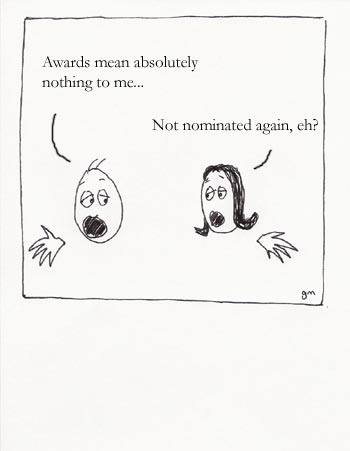
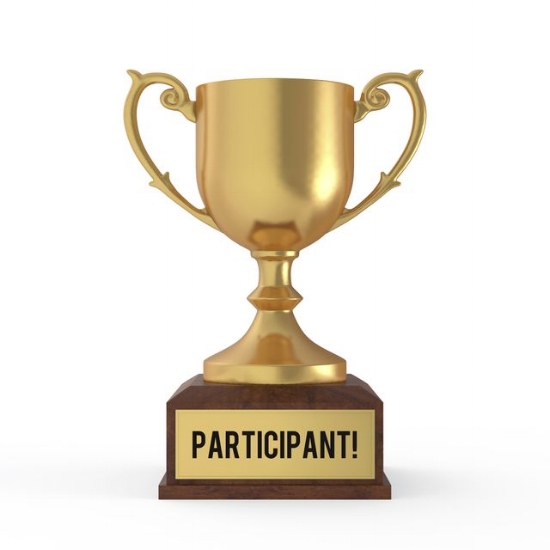
I think prizes are fine, and everyone loves to be part of them/complain about them (see illustration below), but they’re really for the industry as a whole more than any particular book. They’re about reminding people that writing is an endeavor that has artistic intent, as well as about “gamifying” the consumption of that art.

Everyone likes a winner, and award winning books boost sales so that we can all publish our not-award-winning books.

Listen, I’ve been on both sides of the prize fence and I can’t stress enough that sitting on a jury is super-difficult and in many ways super-depressing. You get boxes and boxes of books and it often just reminds you that what you’re doing isn’t special. Hundreds of others are doing it every year. And the vast majority of those efforts are actually competent. They’re fine. Okay. Not spectacular, but not bad.

Then your job is to sift through these steaming piles of mediocrity without succumbing to despair to find something that makes you care about the process again.

Oh, look, poet X has done this thing that jazzes my art-bone. Put that one aside to discuss etc. But after you’ve got your long list or shortlist as a group, well, it’s anyone’s game. The jury will jockey for position and someone will emerge on top. It almost doesn’t matter who, because the point is the shortlist and the news cycle it will generate for the industry. (I really wish people who dig award books knew this and bought the entire shortlist instead of just the winning title… usually, any one of them could have won.)

Sadly, this need for award recognition is so ingrained in the publishing process now because it’s one of the ONLY ways to break through societal indifference. In this way, it’s become both an entire subculture AND marketing strategy unto itself.

Publishers wait two weeks to a month after a book releases to see if it generates buzz and if it doesn’t, they set it on the backburner until awards season. If it gets a nomination bump then, they pick it back up and see how it does. It’s a terrible way to look at art.

That all said, publishing is a business, as is “writing” (once it’s complete). And I think there are some positives to major awards — namely the chance to write and publish more.

In many ways, a literary prize is like a 1up in a video game: the author gets a free life (some money and renown and possibly a new book deal with a hopefully bigger advance), and the publisher gets the same (more sales, notoriety, etc). In the end, it just lets us play a little longer.

Writing may be difficult, but if McGregor’s previous books are any guide, Lean Fall Stand will probably wind up on a few prize shortlists before the year’s out. (His novel Even the Dogs won the International Dublin Literary Award in 2012.) What does he think about prizes? “They mean a range of different things,” he says, then pauses for a long time, searching for diplomatic phrasing. “I think they’re both a useful way of bringing attention to hopefully interesting work, and a fairly shallow marketing trick, or both those things.”

Can copyediting affect societal change?

An interesting piece on how diversity in the copyediting workforce could drive social change. (Of course, I would like to have seen a copy editor go over this piece for two uses of “in recent years” in two paragraphs. But I digress.) As a privileged white writer, this would never have crossed my mind, and it’s a good wake up for me. Change for the better in terms of diversity should really creep into all nooks and crannies of the process.

In recent years copyediting has felt the impact of two cultural shifts. First, in the shift from print to digital media, the publication process has been compressed, and one of the casualties has often been copyediting. As a result, in digital spaces the work of copy editors has sometimes either been heaped onto other editors or done away with entirely. (This explains my own experience of working with copy editors so infrequently while publishing with mostly online publications.) 

The other lens through which to understand the role of copy editors and copyediting is our evolving awareness of the far-reaching impact of racial injustice and inequality, including its effect on the world of publishing. In recent years and months, there has been increased attention to the lack of diversity at all levels of the publishing sector, especially in editorial and decision-making roles. The latest Publishers Weekly survey of representation in the industry, conducted in 2018, reveals that 84 percent of the publishing workforce is white. This lack of diversity fuels an underrepresentation of perspectives in what is published while also contributing to implicit assumptions that readers are white. Writers who make it through the acquisitions gauntlet and have their work accepted then have to navigate the developmental editing, copyediting, and marketing aspects of the publishing process, which may not value the preservation of authentic voices and perspectives of BIPOC writers. I went into my first encounters with copy editors wary, having heard stories of negative experiences from fellow writers of color. Some were dismayed by how their writing had been whitewashed by having culturally relevant language removed or been pushed to include copious explanatory language, detracting from their narrative.