Brontë books

Did you know that Charlotte Brontë* used to make wee books when she was a teen?
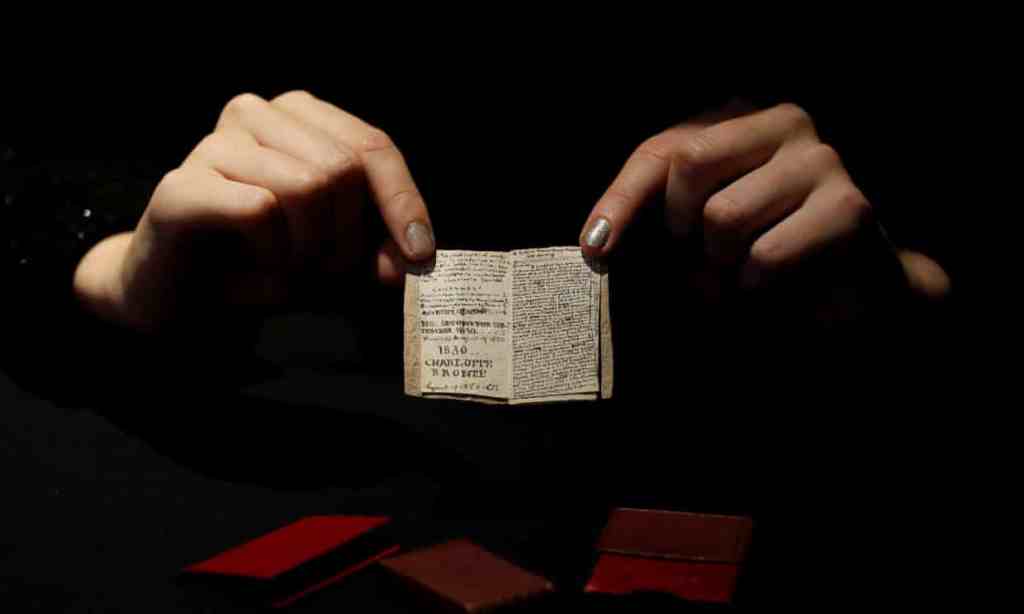
At a Paris auction on Monday, the charity paid €600,000 (£512,000) plus auction costs to acquire the book, which measures just 35mm x 61mm. Written in 1830, when Charlotte was 14, it is part of a series of six produced by the author in her teens. Only five are known to have survived, with one missing since around 1930.

*Did you know Charlotte’s birthday is April 21, but a long long time ago? That makes her a Brontë-Taurus. I’ll be here all week, people.

“I’m not dead yet”: Latin

Latin isn’t dead or useless, says essayist.

I would like to put the reader on guard against one more noxious cliché. Even among specialists one hears the term “dead language” thrown around. This characterization arises from a misconception of how languages live and die, and a hazy distinction between the written and the oral. Oral language is linked immediately with the idea of being alive. But this is a bias. Latin, even if it’s no longer spoken, is present in an astounding number of manuscripts—and writing, particularly literary writing, is a far more durable means of communication than any oral practice. If, therefore, Latin lives on in the most complex form of writing we’ve yet imagined, namely literature, is it not absurd to proclaim it dead?

So what was everyone up to last night? Mostly sitting around, right?

Was there a reading or something somewhere? I didn’t really see much coverage. It’s like there MIGHT have been an event, but I can’t be sure because barely anyone was talking about it.

Congratulations, Ian Williams! Guy has to be on top of the world today. Griffin, Giller…. What’s next? GG for playwriting? While I was pulling for hometown heroes Michael Crummey and Megan Coles, I am glad to see a formally inventive novel (written by a poet, fuckers) win the prize!

cbc

“It’s an engrossing story of disparate people brought together and also a masterful unfolding of unexpected connections and collisions between and across lives otherwise separated by race, class, gender and geography. It’s a pointed and often playful plotting out of individual and shared stories in the close spaces of hospital rooms, garages, mansions and apartments, and a symphonic performance of resonant and dissonant voices, those of persons wanting to impress persuade, deny, or beguile others, and always trying again,” the jury said in a statement.

ChiZine needs a full forensic audit

So, I’ve been trying to wrap my head around this for a week or more now, but this nonsense with ChiZine just keeps getting crazier. Thankfully a generous tipster has sent me a bunch of links to try to make sense of it all. Besides his literary work, the other original Bookninja Peter Darbyshire writes dark fantasy under the name of Peter Roman, including the super-fun, fast-paced Cross series, and has been publishing these with ChiZine the last few years. Sadly, Peter is also affected by what’s gone on. I’m mad in part on Pete’s behalf and in part for those of us who won’t any time soon get a look at the fourth Cross book.

I’ll tell you something for free right now: given the state of this fuck up and the apparent length of time its been going on, if I were working at the Canada Council, I would be setting a speculum into an icebath in anticipation of a full exam up the buttholes of both the company itseld and all the key ChiZine leadership involved. And I think Rev Can and the Bank might want to get involved as well.

Outside Twitter chatter and the spec world news there seems to be very little reportage on this. Time to crack it open, non-blog journalists.

Adam on Leonard’s last

Dang it, I’m not getting any work done today. Adam Cohen is interviewed on his father’s legacy and their last work together.

“I remember while we were getting all of these vocals, I asked him, ‘Dad, what is it that’s causing you to, one after the other, commit such incredibly compelling vocals with relative ease?’” Adam recalls. “It’s an area in which he had often struggled, or at least he felt he’d struggled. He would rattle these readings off almost joyfully from his medical chair, which I had installed in his living room.

“And he said to me, ‘I have never found it as easy to record vocals because I’m immobilised. I can’t move. I’m in such pain, I’ve been stuck in this house for months, and I’ve been doing nothing but singing these songs.’ He was so deeply familiar with the language, with where the beat falls, where the syllables fall within the beat, he was able to, with incredible conviction, believability, character and charisma, deliver these stories completely as himself. I was amazed. Many of these vocals were essentially first takes. They were birthed almost complete. A very rare thing.”

Bowie’s Books

Basically this review of two books on Bowie (one analysing his top 100 books) is a thinly veiled chance for me to start heading down a Bowie Spotify rabbit hole today. Goodbye!

20th-century fiction, books that touched on dadaism and surrealism, two histories of soul music… There were plenty of titles that suggested a curator who had come of age in the early 60s (On the RoadBilly Liar, Colin Wilson’s The Outsider), though with the inclusion of every issue of VizPrivate Eye and the Beano alongside Dante and Homer, the list was democratic, and clearly intended to give pointers on how to live a good life as much as signal an iconoclastic education.

Whatever happened to sci-fi guy John M. Ford?

On resurrecting an obscure author.

The Dragon Waiting is an unfolding cabinet of wonders. Three years ago, over breakfast, my friend Helen handed me a novel about a quest that, unknown to both of us, would set me off on a quest of my own. The book was called The Dragon Waiting, and it was written by the late science fiction and fantasy author John M. Ford. Helen placed the mass-market paperback with its garish cover in my hands, her eyes aglow with evangelical fervor, telling me I would love it. I would soon learn that, owing to Ford’s obscurity, his fans do things like this all the time. Soon, I would become one of them.

Over a decade before George R.R. Martin wrote A Song of Ice and Fire, Ford created an alternate-history retelling of the Wars of the Roses, filled with palace intrigue, dark magic, and more Shakespeare references than are dreamt of in our philosophy. The Dragon Waiting provokes that rare thrill that one gets from the work of Gene Wolfe, or John Crowley, or Ursula Le Guin. A dazzling intellect ensorcells the reader, entertaining with one hand, opening new doors with another.

Sweden pokes sleeping panda China, presumably with piece 87a from the Hëpövukävarklësch end table set

Sweden has given a freedom of the press type prize to a jailed Swedish/Chinese author and China is getting all riled up about it. China is really just leaning in to this totalitarian dystopia thing, isn’t it?

Sweden’s culture minister on Friday awarded the annual Tucholsky literary prize to a Chinese author despite a threat from the Chinese ambassador to ban her from entering the country.

Author Gui Minhai, a naturalized Swede and co-owner of a Hong Kong store that sold gossipy books about Chinese leaders, was detained by police in eastern China in 2018 while in the company of two Swedish diplomats with whom he was traveling to Beijing.

Cities of Literature

Not a Calvino book, but a designation by UNESCO. Aren’t they the ones that collect pennies at Halloween? Nevermind. What does it mean to become a city of literature? My guess is that there’s probably fewer seats at the coffee shop and the avocado toast is on seedy bread. But don’t listen to me, kids! Everyone’s got a book in them… Follow your dreams! (Spoiler: the destination is the welfare office.)

The nomination criteria for Cities of Literature include the quality, quantity, and diversity of editorial initiatives and publishing houses; the quality and quantity of educational programs focusing on domestic or foreign literature in schools, including universities; an urban environment in which literature plays an integral role; experience in hosting literary events and festivals promoting domestic and foreign literature; the existence of libraries, bookstores, and cultural centers that can promote and disseminate domestic and foreign literature; an active effort by the publishing sector to translate literary works; and involvement by the media, including new media, in promoting literature and strengthening the market. Cities of Literature nominated thus far have included Norwich, Edinburgh, Melbourne, Dublin, Iowa City, Reykjavik, Baghdad, Quebec City, and Krakow.