“Critique is a fundamentally negative gesture.”

That oughtta curl a few toes in soft academic shoes (and maybe tent a few other robes) out there. This essay extols the virtues of reading aloud in a group WITHOUT using your critical mind. This is something I struggle with (even while reading silently). I hate not being able to turn off the critical brain. But after 25 years of reading, writing, and teaching poetry, I find it very difficult. Same thing happened to me with the theatre: I can’t even go to a fun show with seeing the blocking, lighting choices, directorial interferences, actor posturing, etc. All that’s left to me is film. So if you know how they get all those people inside the flat box in my basement, please don’t tell me.

Praise isn’t a thing we literary academics tend to excel at. Weaned on the likes of Karl Marx and Michel Foucault, our critical minds are wired to “problematize” not praise. Here, we are trained to say, is how this particular text is complicit in this or that insidious ideology — or, somewhat more positively, how it helps us critique an ideology, or a form of oppression or inequality. And who can blame us? We live in a country where the less affluent 50 percent of the population now possesses around 1 percent of its wealth, and each successive week seems to bring a new instance of racialized violence. Not to critique these ills, as they become visible in literary texts, would amount to self-delusion.

Yet we are left, many of us critics, with a deep-down impulse to praise, and the above formula does little to sate this need. If we are only going to “interrogate” literature (that favorite word!), why read at all, much less devote our careers to these works in spite of all the pressures, monetary and otherwise, that scream at us to stop and turn around? Critique is a fundamentally negative gesture, and as one’s default readerly mode it leads to a kind of attrition. At the end of the day we all need to eat — and praise may be the first step toward attaining sustenance, the utterance of thanksgiving before the feast. A world transfigured by praise is one worth living in — and, crucially, one worth renovating, endeavoring to reform. Praising it, we impose on ourselves a degree of humility and receptivity to others and their gifts, to nature with its superabundance of beauty and wonder that cries out to be cataloged and shared. We remind ourselves that humans can be remarkable during a time when being human is so frequently cause for shame.


On the power of the pre-order

Know someone with a book coming out and want to help them without putting in too much effort? Pre-order it.

When authors shyly, or not so shyly, encourage people to pre-order their book, they are hoping readers will order from a book shop, online, or from their library in advance of the publication date – regardless of the format. It can be career-changing for an author and this is why:

Americans get Dirty

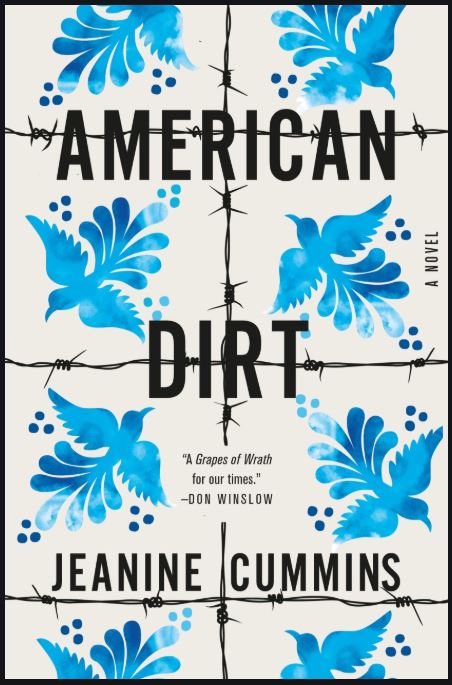
So, there’s a huge appropriation scandal gone nuts in the US around the white-woman-writes-about-Mexicans book American Dirt. It was supposed to be a huge triumph for the author and publisher and while I expect the negative attention hasn’t hurt sales so much, it does seem to have been a remarkably tone-deaf and bad-timing decision on the part of everyone involved. Was there no one at any boardroom table that went, “Really? Are you serious? Right now?” Anyway, before you conservative types start yapping about the artist’s right to cultural appropriation, it looks like the real controversy didn’t erupt until passages of writing started to emerge that showed the “author’s portrayal of Mexican culture [as] outlandish, littered with stereotypes, stilted bilingualism and an awkward peppering of italicized Spanish phrases.” Now there’s an open letter (!!) signed by 82 authors asking Oprah to reconsider her choice to pick this book for her club. Thoughts?

Its publisher, Flatiron Books, an imprint of Macmillan, paid a seven-figure advance after outbidding several competitors for the novel. It snagged a coveted selection in Oprah’s Book Club and had been shipped to key celebrity influencers, including Stephen King, Sandra Cisneros and Salma Hayek. A reported first run of 500,000 copies was printed. The film rights were sold.

But by week’s end, the novel “American Dirt” had garnered attention that its boosters likely didn’t expect: angry charges of cultural appropriation, stereotyping, insensitivity, and even racism against author Jeanine Cummins, who herself said in the book’s author’s note, “I was worried that, as a nonmigrant and non-Mexican, I had no business writing a book set almost entirely in Mexico, set entirely among migrants.”

Teens and reading

How do I get my teen off the phone and back to reading like they did when I was in control and they weren’t a person with will but rather a excised growth that I told what to do every minute of the day. (Psst, hint from the other side of parenting: if you truly taught them well as children, they’ll come back to it after the teen years are over…)

This is what teens look like now, right?

Children grow up with such varying experiences that it can be so hard to pinpoint the element which will transform your child into a “reader” rather than just someone with the ability to read. That spark inside a child, which allows them to cross the threshold of the written word into an entirely new world, is something which can’t be taught, only really nurtured and developed.

Vancouver Public Library <3s TPL policy

So, the Vancouver Public Library has decided to double down on the TPL policy of letting hate-groups-in-disguise speak. I don’t know how I feel about all this. I mean, I do. But I’m conflicted. While I heartily condemn these groups, and I imagine their very existence is threatening to people who have already experienced lifetimes of marginalization and fear, I am also a supporter of the right to gather and free speech. What bothers me is that these groups are using acceptance and space at mainstream public institutions as a way to legitimize what is essentially a campaign to stamp out the rights and opportunities of others before they’re even fully realized. I sympathize with the difficulty of the decision making for the library boards, is what I’m saying. That said, I would have just made a different decision based on my interpretation of what Canadian public values are and I would ask them to consider this: what are our public spaces for? When you allow a group in to discuss whether another group deserves the same rights and privileges as other Canadians, how does that change the space for everyone? Not just those immediately affected by the panel, but everyone to come. The library is one of the last sacred, engaging, utilitarian, and “free” spaces for us ALL to gather. I see no problem with holding that outside the polarizing politics of our moment. It should be a space for bringing people in, not for shutting people out.

“After a difficult and emotional discussion, a majority of the Board decided to accept the rental request,” de Castell said in the statement. “As with other room rentals, acceptance of this rental request does not mean that the Board endorses or agrees with the positions of the group or individuals using our space.”

On influencers

I kind of hate that word now. I just see disease when I look at it. Like “influencer” is the social version of the biological influenza. And my advancing age makes me cranky enough and vaguely conservative enough to doubt whether most people who would call themselves such actually read. But that said, Publisher’s Weekly has some tips on how to get your (self-published) book into the hands of influencers (cough, hack, spit) who will support it, whether or not they’ll bother to read it.

Everyone wants earned media, but, though it comes without cost, it does require effort. Because outlets that cover books are shrinking or disappearing, there is more competition than ever for reviews and attention. Still, traditional book publishers’ marketing plans tend to focus on securing earned media that they know and have experience approaching. These include recognized review publications, as well as TV, radio, print, and online outlets.

As self-published author, you should seek alternative options to gain momentum. These include local and regional media, influencers in your target market, and any person who is likely to answer your emails or pick up the phone when you call.

New in the news

Machine AIs: better at harvesting your biochemical electricity than poetry

Well, I could have told you that. In fairness, I’ve taught a lot of intro poetry courses, and I’d put some of these at a solid B+ for fledgling writers.

For its training, GPT-2 was given a corpus of 8 million webpages, chosen with a quintessentially internet-y method of natural selection: “In order to preserve document quality,” OpenAI’s post states, “we used only pages which have been curated/filtered by humans—specifically, we used outbound links from Reddit which received at least 3 karma.” Through trial and error, GPT-2 learned how to predict the rest of a piece of text, given only the first few words or sentences. In turn, this gave it a general method for completing other texts, regardless of content or genre.

Wait a friggin minute — you used Reddit to help teach an AI? Sweet merciful baby Jesus. We’re all going to die.

Frodo = unfinished laundry?

Was Tolkien a scholarly procrastinator? Well, this certainly explains the tediously long the “heather and weather”, as I called them, descriptions. That said, boy, does this ever give me hope — the thought of John picking away at Frodo and The Gang while his actual work languished. It’s relaxing because I also am currently writing a fantasy novel to avoid “real” work. Sigh. Dreamy.

Now, there’s a second breakfast face of great comfort

For so many years, in short, he had been loafing in his scholarly career as a losel who squandered time on children’s stories when he should have been whipping his Beowulf book into shape. He confided to his publisher in 1937 that Oxford would merely add The Hobbit to his “long list of never-never procrastinations” (Letters, 18). Fiction-writing simply did not count in terms of academic production, especially after Tolkien had idled away his two-year Leverhulme Research Fellowship. “The authorities of the university,” he would lament when The Lord of the Rings was in press, “might well consider it an aberration of an elderly professor of philology to write and publish fairy stories and romances” (Letters, 219). He explained to his American publisher this widespread view of his failings: “Most of my philological colleagues are shocked (cert. behind my back, sometimes to my face) at the fall of a philological into ‘Trivial literature’; and anyway the cry is: ‘now we know how you have been wasting your time for 20 years’” (Letters, 238). His enormous effort during the late 1940s in the cramped row-house without even a desk—”I typed out The Hobbit—and the whole of The Lord of the Rings twice (and several sections many times) on my bed in an attic of Manor Road” (Letters, 344)—was little known because it simply did not count.

Pullman’s biggest fight yet

After taking on the Catholic Church, Philip Pullman really has his hands full with his next fight: the preservation of the Oxford comma. For what it’s worth, I side with Philly P on this one.

It is a debate that has torn the nation in two, ripped friends and family apart, and entrenched deep and uncrossable lines throughout the land. Should the Royal Mint have used an Oxford comma on its Brexit 50p piece?

Three million coins bearing the slogan “Peace, prosperity and friendship with all nations” are due to enter circulation from 31 January, with Sajid Javid, chancellor of the exchequer, expressing his hope that the commemorative coin will mark “the beginning of this new chapter” as the UK leaves the European Union.

However, early responses include His Dark Materials novelist Philip Pullman’s criticism of its punctuation.