Scandal time!

There’s a new literary scandal brewing in the USA, which is a relief, because we all know it’s be very quiet and friendly around here lately. But seriously, this one doesn’t even seem to involve a man who abuses power to gaslight, assault, and defame women. Though it does once again seem to be centred around white people casually and/or cluelessly taking advantage of the oppression machine we’ve created over the last several thousand years. #babysteps? #progress? #makescandalsgreatagain?

As you may have noticed if you’re a person who follows Literary Twitter in any fashion, online controversy over Jeanine Cummins’ new novel American Dirt exploded over the weekend. If you aren’t, or if you were engaging in a digital detox this weekend, here’s what you need to know:

In 2018, Jeanine Cummins, who is white (but who recently revealed that she has a Puerto Rican grandparent), sold her novel American Dirt, described in Publishers Marketplace as “the story of a mother and her young son as they try to cross the border into the United States, fleeing their Mexican city, which has been taken over by a drug cartel,” for seven figures, after an auction between multiple publishing houses. Rights were promptly sold to a host of other countries, as is common in such cases.

As is also common for novels purchased for large sums of money, the publicity machine soon began churning, and by the time we made it to the beginning of this year, American Dirt had gotten a lot of early praise, and was on tons of Most Anticipated lists (including ours).

And it goes downhill from there.

All hail the Aurora Awards

The Aurora Awards seek to basically represent the pinnacle of the Canadian spec fiction (with the usual caveats that come with talking about any literary horse race) and I can tell you first hand that they do work, at least in terms of getting Canadian books publicity in a market choked with Americans. As a kid I was a huge reader of fantasy and scifi, a habit I have recently returned to. Many of you might not remember this, but there was a time before the internet when you couldn’t just type into Google “Canadian Science Fiction authors” to find out if your homeland produced its own Ursula Le Guins, Larry Nivens, David Brins, and William Gibsons. Wait. Anyway, I discovered Judith Merrill because of them, as well as many others. It was Cory Doctorow in his days at Bakka on Queen Street in Toronto who told me about them, I believe. He, or someone else there, also told me about the Tesseracts anthology (yes, I think there was only one then), which also felt like a real discovery. Anyway, point being: happy 40th anniversary, nerds.

Image by Paul Vermeersch

Now in its 40th year, the Aurora Awards – the highest accolade in Canadian science-fiction and fantasy publishing – help foster community and fan culture through its public-voting system that celebrates small presses and indie authors.

The Canadian Science Fiction and Fantasy Association (CSFFA) has been presenting the Aurora Awards to exceptional works of science fiction, fantasy, and horror since 1980, honouring such authors as William Gibson, Robert J. Sawyer, and Judith Merril. 

On writing in your books

I don’t write in books I give as gifts anymore, unless they are books I wrote (in which case, I am totally cheaping out on your gift because I likely got the book for free). But that said, I used to love combing through the stacks at The Strand and daydreaming about who owned books before me. I also LOVE other people’s marginalia. Most of it is so dumb that it makes me feel better about my own prowess as a reader. And best of all is when you find something tucked into the cover a book, like a letter or show tickets or even an old bill. It’s got a strangely archeological feel about it. Like you’re a nerdy Indiana Jones.

Among bibliophiles, the debate can be polarising and nuanced. For example: is it ever acceptable to write in a book? If yes: in pencil, pen or – heaven forbid – highlighter? Are all books fair game, or just some? And once they are so “defaced” – can you ever then give them away?

For some secondhand buyers, motivated more by sentiment than money, the traces of past readers are part of the appeal of what Virginia Woolf termed “wild books”. In his pursuit of a complete set of Picadors, author Nicholas Royle has amassed a collection of paraphernalia tucked inside their pages: business cards, boarding passes, photographs, cheques, currency, love letters. “I call these things ‘inclusions’, like flies or bits of bark caught in amber – because they’ve stopped time, in a way.”

Hey, conservative dickwads: “they” is older than “you”

I just don’t get what everyone is always freaking out about. Languages evolve, and revolve, depending on need. I mean, there are many, MANY more important ways to “defend the language” than pretending your losing (and perhaps under-acknowledged?) ideological stance is based in a desire to protect. Anyway, get over it. If you’re stewing for a language fight, go after business speak or something.

For the still unpersuaded, he points out that singular “they” is older than singular “you.” Only in the 1600s did singular “you” start pushing out “thou” and “thee.” Having the same pronoun for both singular and plural forms makes for potential ambiguity. So colloquial plural forms have sprung up, such as “y’all,” common in the American South, or the more recent “you guys” — an oddly gendered locution at a time when the generic “he” is becoming extinct. Still, we get by. No one considers ditching the singular “you.”

For Baron, the benefit of singular “they” is that it is often used by those in search of a nonbinary or gender-neutral pronoun, as well as those who give such issues little thought. While many language mavens are coming around reluctantly to singular “they” — in December Merriam-Webster anointed “they” its “word of the year” — this newspaper is among those publications still holding out against it. The paper’s defense is convention. I admit that the nonbinary use of “they” to refer to a specific person — “Alex likes their burger with mustard” — still sounds jangly to my ears. I will get used to it. Language, as Baron eloquently shows, works as a dynamic democracy, not as rule by experts. The sticklers may not like “they” (singular) but they (plural) will eventually have to bow to the inevitable.

Linkers in a dangerous time

Dear Ninjas, it’s nuts here. Grocery stores opened today for the first time since Thursday and it looks like a 1982 Romanian bread line. Except it’s full of Newfoundlanders so everyone is laughing. Anyway, we have milk now and I imagine the state of emergency will be lifted closer to the weekend, so stability is on the horizon. Just no more snow, please.

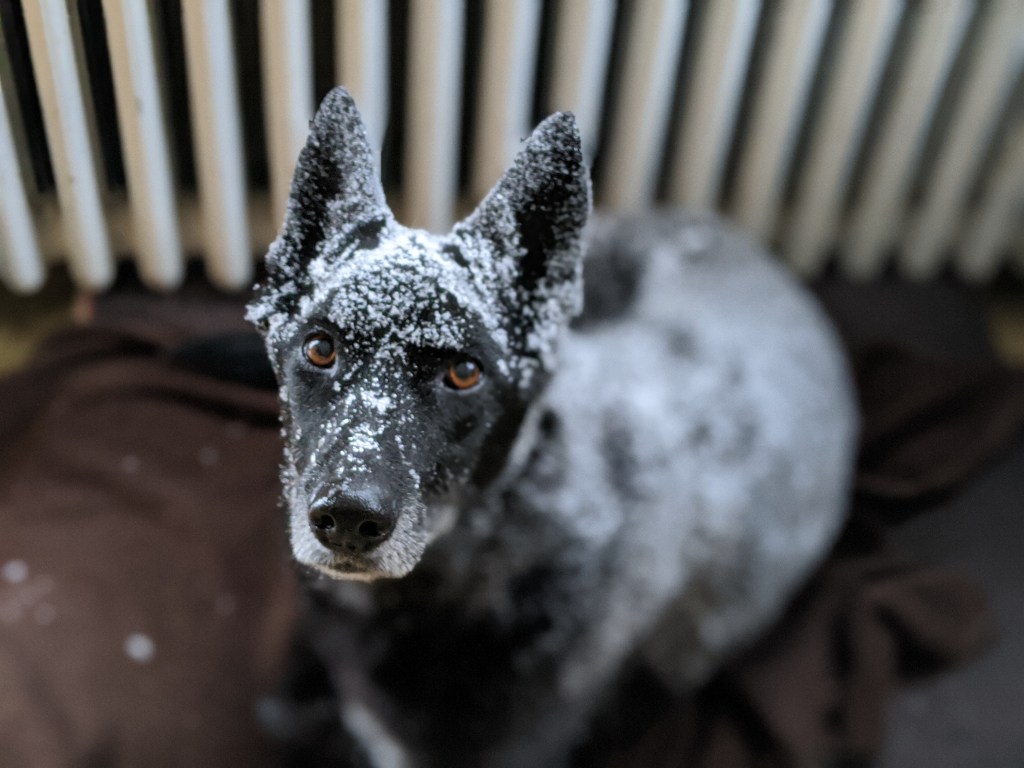
Ninja dog Mitsou, currently known as Sleetsou, welcomes you to the link dump of Snowmageddon 2020

The benefits of that “antilibrary” you never get around to

Are all the books you haven’t yet read, but still have on your shelves (your “antilibrary”, as they call it here), worth more, spiritually, intellectually, and psychically, than the ones you have read?

The antilibrary’s value stems from how it challenges our self-estimation by providing a constant, niggling reminder of all we don’t know. The titles lining my own home remind me that I know little to nothing about cryptography, the evolution of feathers, Italian folklore, illicit drug use in the Third Reich, and whatever entomophagy is. (Don’t spoil it; I want to be surprised.)

“We tend to treat our knowledge as personal property to be protected and defended,” Taleb writes. “It is an ornament that allows us to rise in the pecking order. So this tendency to offend Eco’s library sensibility by focusing on the known is a human bias that extends to our mental operations.”

Pushland

A theme park based on the fairy tales of Pushkin? Givver. But Alison Flood (who I seem to have been linking to on Bookninja for nearly 20 years) takes it a step further. Why not other writers? Stephen King for instance? I’d hit that ride. Please exit the blood tub to the right through existential dread turnstiles and remember to take all your body parts with you.

If we can have Pushkinlandia, then what else can we hope for? Discworld World? A Stephen King-themed park, hopefully in Derry, Maine? Looking into this, I discovered the delightful fact that Universal Studios Florida did once plan “an elaborate dark ride” themed on the master.

“Part-way through, riders would pull into the unload station and hear the usual instructions on how to exit without extensive bodily injury. But the restraints wouldn’t lift and the ride wasn’t over. A Shining-sized deluge of blood would flood out of the exit doors, Pennywise Itself would spring from the control room and riders would hurtle deeper into the nightmare/toward the gift shop,” reveals the Bloody Disgusting website.