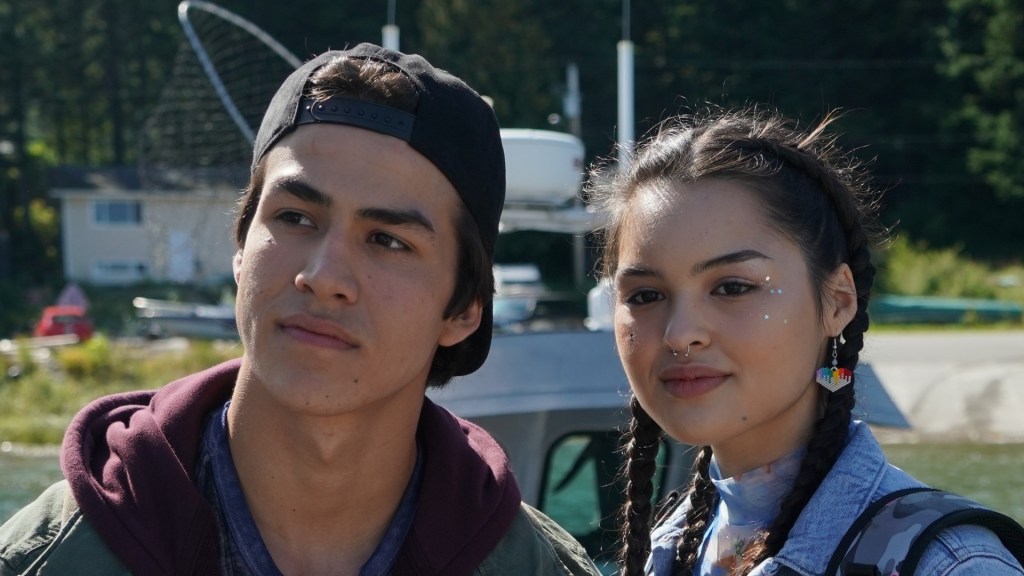
Eden Robinson has given her blessing to the cancellation of Trickster, based on her book Son of a Trickster, after revelations that the show runner was what my friend Michelle would angrily call a “Pretendian” (you know, like Joseph Boyden). That’s all well and good, and I see why, but tons of people are out of a job suddenly on what was, by all accounts, a decent show. I’ve read the book, but not seen the show, so I can’t speak to the quality, but I can say, that’s a whole lot of unemployed Indigenous professionals who are sort of double-screwed by circumstance and misappropriating white people. Drew Hayden Taylor says the CBC should reconsider. Given the intricacies of contracts (how much of this property is tied contractually to Latimer, etc.) I suspect that’s harder to do than it seems, but it’s worth investigating.
Latimer, who also directed all six episodes of the series, came under scrutiny in December when she failed to adequately explain her Indigenous ancestry. Robinson herself apologized on Facebook and pledged to donate her future author royalties from the series to the Haisla Language Authority.
“We have had many conversations over the last few weeks with a view to continuing production on a second season of Trickster,” CBC said in a statement. “Those conversations included producers, writers, actors, and the author of the books on which Trickster is based. Fully respecting everyone’s perspective, season two will not move forward as planned, unfortunately.”
Jezebel goes for the jugular, as expected. An interesting and timely piece here on the difference between a reader and a “Book Person”. Of course, I hear “Book People” and just think of Coles. But seriously, are Book People ruining books? (I reserve the right to have my answer differ unexpectedly from yours.)
A reader is someone who is in the habit of reading. A Book Person has turned reading into an identity. A Book Person participates in book culture. Book People refer to themselves as “bookworms” and post Bookstagrams of their “stacks.” They tend towards language like “I love this so hard” or “this gave me all the feels” and enjoy gentle memes about buying more books than they can read and the travesty of dog-eared pages. They build Christmas trees out of books. They write reviews on Goodreads and read book blogs and use the hashtag #amreading when they are reading. They have TBR (to be read) lists and admit to DNFing (did not finish). They watch BookTube and BookTok. They love a stuffed shelf but don’t reject audiobooks and e-readers; to a Book Person, reading is reading is reading.
Well, it’s Friday. Not that that means much anymore. How are those walls holding up? Paint still on them? New millimeter of wall paper peeling? Anything happening outside the window in the alley? Didn’t think so.
In a statement published on her blog, Roberts said she was “simply and sincerely appalled” by readers who left hateful comments on a Facebook post announcing that Milano would star in the Netflix adaptation of her romantic suspense novel.
“The vitriol, the hatred, the anger, the bitterness and the demands are astounding to me,” Roberts wrote. “I’m a liberal Democrat. Always have been, always will be. And as one, I’ve always believed everyone has a right to their political beliefs, and has a right to express their opinions. But I don’t have to tolerate insults and ugliness on my page.”
Poets know the drill better than anyone except short story writers: the thoughts that creep into the back of your head; when you’ve sent your book to the publisher, but haven’t started on something new, or when your royalty statement comes and you realize you haven’t earned out your meagre advance, or when you never even get an advance at all because the publisher already knows something you do not…. It’s he cold, creeping fingers of doubt that scurry around your occipital bone, like an existential panic attack, but without fear of death. Or at least biological death. If no one is reading you, why do you bother?
But experiencing this polar dip into futility is good for some of us. It’s as freeing as freezing.
When you’re new at writing and pretty sure you’re going change the world with your words, it can be a big high. But when you grow up a bit and realize you might only ever change five people’s worlds (Hell, even 100 people’s worlds), well, that’s a bummer. Except, once you get past feeling sorry for yourself that no one recognizes your genius, how freeing is it to have decided to not care? To not please everyone? How far can you take your art when you’re not worried about it being consumed? So, is no-readers the end of the line for an author, or the start of the race? Time will tell with each who goes this way. But I suppose if we’re still thinking about it, I suppose we’re not quite there yet.
Books are now published in numbers so vast that the writing of one can no longer be presumed to be an act of communication between writer and reader. Yet even books that aren’t read, and stand little chance of ever being read, can have their value.
Extended prose offers the author a chance, one never to be encountered in conversation, no matter how patient one’s listeners, to comb slowly through her own mind at her own pace, sorting out her thoughts, reflexively exploring her sensibilities. Along the way, catharsis too may be in the offing; any troubling feelings discovered by the author, either in advance or in the process of writing, may be discharged, if the writer can only figure out how—without needing to involve readers in the least.
Costa book of the year goes to Roffey (Which one is Costa again? The constant chase for corporate funding, and therefore renaming, means I have no idea which award is which anymore);
A writer who finds herself in the category explores its history and current state. We like our labels, that’s for sure. I don’t know why, but I suppose I get it. It’s like the wee signs that hang over the aperture to each aisle in the grocery store. Ah, THIS is where the cereal is (even though I have been going to that same damn Sobeys for 15 years.) There’s something comforting to not having to spend a moment thinking or exploring options if you are simply looking for whole grains. That said, when it comes to words on a page, I prefer a wider lens on the whole thing: “fiction”, “poetry”, “other stuff”. Etc. Allows me to sometimes find something outside my comfort zone. And the term “domestic fiction” is certainly outside my comfort zone.
The phrase “domestic fiction,” to me, brings to mind oval-shaped rag rugs catching embers and a cast iron skillet full of hash-browns and women in calico dresses setting the table. Basically, it is Little House on the Prairie. Why would my novel, about an itinerant bilingual mother and daughter who do not have a permanent home and zigzag across the Atlantic at a frenetic pace, the long and complicated legacy of the Spanish Civil War overshadowing their every move, be in such a category?
A bit of research shows my instincts about the label aren’t far off. Going back to the 19th century, I learn that “domestic fiction” is often synonymous with “women’s fiction” and “sentimental fiction.” There are a range of authors, from Harriet Beecher Stowe to Jane Austen, and conventional themes, including struggles with class, religion, and marriage. It is a fascinating genre, and some would argue it had a major role in bringing womens’ lives into literary and social discourse.
Two centuries later, I ask, what I am doing in this category?


 Bookninja