Judging by the state of my house, I’d say any more than two books at a time. Seriously, we probably have 3000-5000 books in this house, overflowing from the damn shelves and into boxes in the basement that haven’t even been unpacked since the move-in seven years ago.
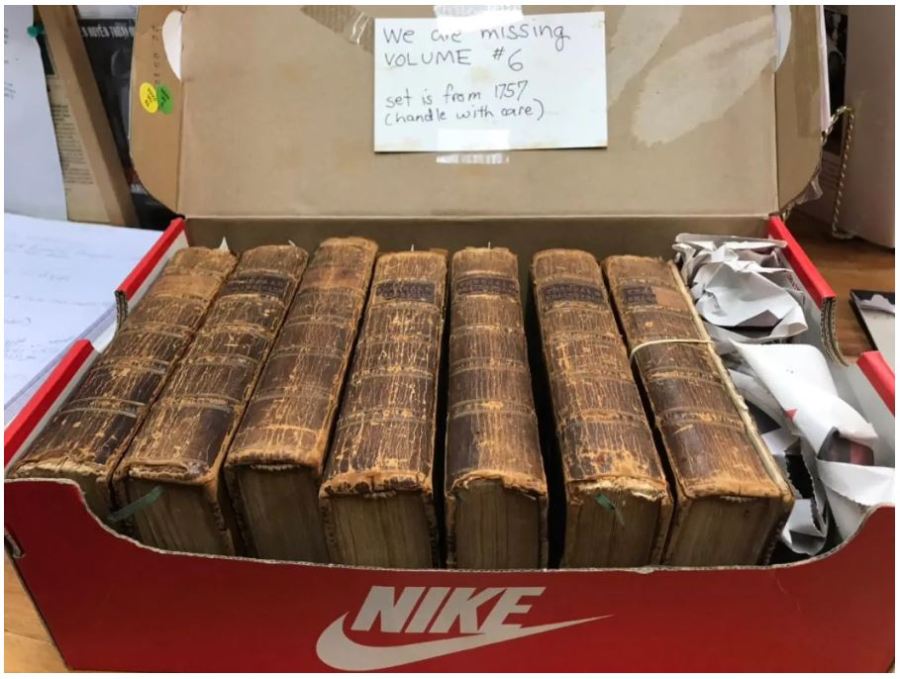
The new head of the New Brunswick Public Library Service got rid of a significant collection of books at the Kings Landing library when he was in charge of the historical settlement, according to a former employee.
Darrell Butler helped build up the Kings Landing library over more than 40 years as the chief curator and manager of heritage resources.
The books dealt with topics such as the history of agriculture, wagons, furniture and ceramics, and staff used them for research and reference, said Butler.
“The books were very specialized and, well really, they were collectors’ items, some of them individually worth over $100,” he said.
But in 2016, when Kevin Cormier was the CEO of Kings Landing, Butler discovered some of the books for sale at Value Village in Fredericton.
Actually, it’s sort of one of many. But let’s focus on this one from the Guardian: You can’t be a writer unless you can afford it. Speaking as someone currently living on grants and credit, I don’t know if that’s true. But what IS true is that I can’t be ONLY a writer unless I win a lottery or find out I am the illegitimate lovechild of Bill Murray and sole heir to his fortune. (Guardian is making you register now to read the articles, for some reason, but you can register easily with Google or Facebook and it’s free after that. What’s another company having your info mean if you get to read articles about how terrible your life is?)
Once, before a debut novelist panel geared specifically to aspiring writers, one of the novelists with whom I was set to speak mentioned to me that they’d hired a private publicist to promote their book. They told me it cost nearly their whole advance but was worth it, they said, because this private publicist got them on a widely watched talkshow. During this panel, this writer mentioned to the crowd at one point that they “wrote and taught exclusively”, and I kept my eyes on my hands folded in my lap. I knew this writer did much of the same teaching I did, gig work, often for between $1,500-$3,000 for a six to eight-week course; nowhere near enough to sustain one’s self in New York. I knew their whole advance was gone, and that, if the publicist did pay off, it would be months before they might accrue returns.
I did not know what this writer, who I thought was single, paid in rent, or all the other ways that they might have been able to cut corners, that I, a mother of two, could not cut, but even then, it felt impossible to me that this writer was sustaining themselves in any legitimate way without some outside help. I thought, maybe, when they said “write” they might be including copywriting or tech, as some others that I know support themselves.
Listen, people, I need to get something out of the way: I live on an island in the middle of the North Atlantic for a reason, so, bear with me a moment while I outline something. I really don’t want you to take this the wrong way, but if this virus turns into some version of the zombie apocalypse, especially given the SPECTACULAR SHITSHOW that is the American response to its advent in the States and the fact that our government can’t even follow through on some basic election promises much less take its mind off oil long enough to think of other things, I’ll be advocating for locking down the airports and docks and riding this motherfucker out while you all die. No offense, but I have not only done a lifetime of post-apocalypse reading, I’ve also played four of the five Fallout franchise games, and I am totally prepared to don some studded leather outfits, trick out my Mazda 5 with wheel spikes, and spray paint my teeth chrome. And before you even think about getting on a homemade boat and paddling over this way to escape, just remember, I’ll be waiting on the beach with a shotgun modified to shoot alternating rounds of rock salt, penicillin, and shrapnel made of Black Horse beer bottle caps.
Zadie Smith, someone who looks like Hermione from the movies, and that guy with the eyebrows who came along while I was gone are up for the Folio Prize;
This wee Vermont paper marvels at the change in the modern library. Sometimes when I see things like this, I am both happy that the American public still receives the occasional article about intellectual pursuits, and sad that this article wasn’t appearing 10 years ago when some of the idiots now voting down there were still young enough to be educated.
Though these murmured conversations, rustling pages and clicking of digital devices did not exactly equal silence, every patron on all three floors of the Fletcher Free was in shush mode, as if a librarian with finger to lips stood before them. As if this place were considered sacred. Yet when a gaggle of children burst through the front door with unrestrained outdoor voices, no one looked up. The bubble of excitement soon disappeared into a kids’ yoga class.
Anyone who has ever entered a library is familiar with this scene — the self-enforced hush, the attitude of tolerance, the freedom of access. But if you haven’t been to your public library in, oh, the past 10 or 20 years, you might be surprised by how things have changed.
Did you know that Russia had its own Doctor Seuss? It sure did. This was, of course, back when its main exports were grimaces and despair instead of porn stars, mob money, and the puppeteering of intellectually hobbled US Presidents. Classics include: Hop on Comrade Pop; The Cat in the Gulag; Red Eggs and Ham; One Fish, Two Fish, Red Fish, No Groceries Today; and To Think That I Saw [Redacted] On Mulberkov Street.
Let me tell you something about children’s poetry: people tend to create it for the right reasons. I was taught this concept in connection to medieval lyric poetry. My teacher’s point was that art made in the modern world is under scarcely any obligation to be good. It can be interesting instead, or new. Or it can “bear witness.” Being good—actually good—is even considered a little passé.
The minute you bring a six-year-old into the picture, though, everything changes. She doesn’t care whether what you’re doing “serves as a useful critique.” She wants it to be good. Consequently, if I’m in a used bookstore and I see a book called Thai Children’s Poetry or Setswana Children’s Poetry or Inuit Children’s Poetry, I pretty much buy it on contact. One wants to know: Does Botswana have a Dr. Seuss? Does Thailand? ’Cuz if they do, I need to know about it.
Russia had a Dr. Seuss. Same deal as ours, except his hot decade wasn’t the fifties; it was the twenties. There’s a lot to be said here.
Look, down there through the killing floor…. We’re going to pack it all into a sausage casing and put in on a bun. Your eyes will be the ketchup bottle and your attention the ketchup. Enjoy your lunch…time reading!
Besides police racial profiling, horrific comments section posts from basically everyone in Alberta, and the near-weekly news that our hot prime minister going back on his election promises (such as proper reconciliation with indigenous peoples), there are other reasons for Canadians to remember we’re not so high and mighty when it comes to progressive thinking: 29 books that have been challenged here;
Why do found texts fascinate us so much? Reader Hans commented on Facebook recently that he in fact collects used books with long, personalized inscriptions…
As I tell my kids: when a space you’d like to occupy either excludes you or doesn’t exist, make your own. Bravo/brava, good people of Tragic. Inclusive spaces in Philadelphia for the win!
I named my Philadelphia reading series Tragic: The Gathering because of the cheeky wordplay related to the popular collectible card game Magic: The Gathering, yes, but also to poke fun at the expectations placed on literature from trans writers. There’s nothing tragic about the energy in a room of people laughing and vibing and responding to Kayleb Rae Candrilli’s work about gender euphoria at the beach or Gen Z audience members suddenly reevaluating the professional wrestling their dads watched in the 80s because of Colette Arrand showing us the homoerotics of the squared circle. And there’s nothing tragic about Raquel Salas Rivera disrupting binary notions of what a literary reading is by reading all their work in both Spanish and English—Spanish first.
When a crowd comes together to feel fully themselves and show out with looks to prove it, as in lii xu’s head-to-toe floral prints, Noor Ibn Najam’s fishnet crop top, or Lily Kulp’s vintage faux fur, it’s a powerfully uplifting experience, and I started Tragic: The Gathering in part because I needed a series like this.
There’s a guy I know here who is self-published, mostly through Amazon these days. He writes military scifi and has built himself enough of an empire to live off his royalties from Kindle. More power to him. We chatted recently and when he asked what I was working on and I told him a fantasy novel, he perked up. “How long is it and how long has it taken you?” he asked. At the time I said, “150 pages so far an I’ve been at it for two months.” I was frankly pretty proud of the turn around time. “Hey, that’s decent. I write one every three months.” I said, “Excuse me? A whole book?” He said, “Yeah, and that’s slow. If I wanted to really work the algorithms, I should really do one a month.”
Well, my friends, I can tell you that I left that conversation with a lot to think about. The worth of art versus dollars being foremost among them.
If you google the words “self-publishing stigma,” you’ll find enough material to fill a book.
The search results for this phrase are packed with articles and blogs, many of which pose similar questions: Where does the stigma around self-published fiction come from? Is it justified? And as the years roll by, is it finally starting to fade?
While questions over writers’ and publishers’ attitudes to this type of fiction may be up for discussion, though, one thing seems pretty clear: A whole lot of people read self-published books.
And a whole lot of writers are making money from selling them.








 Bookninja